



Bandung, UPI
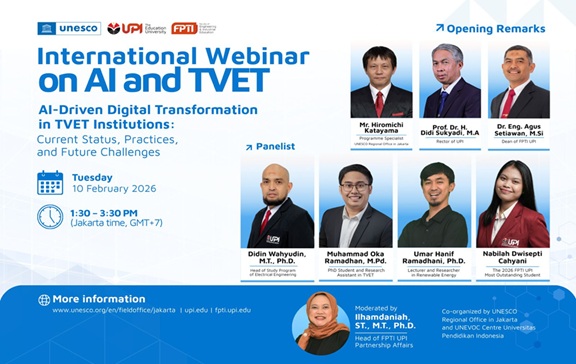
The Faculty of Engineering and Industrial Education (FPTI) at Universitas Pendidikan Indonesia (UPI), in collaboration with UNESCO, successfully organized an International Webinar on AI and TVET titled “AI-Driven Digital Transformation in TVET Institutions: Current Status, Practices, and Future Challenges.” The virtual event was held on Tuesday, February 10, 2026, and attracted 255 participants from various countries, including Indonesia, Thailand, Malaysia, Brunei Darussalam, the Philippines, Japan, China, Cambodia, the Netherlands, and Germany. Participants comprised educators, researchers, students, and vocational-education practitioners.
Advancing AI Integration in TVET
The webinar explored the role of Artificial Intelligence (AI) in strengthening Technical and Vocational Education and Training (TVET), covering key areas such as:
- enhancing research productivity and scientific publication,
- integrating AI into sustainability oriented vocational learning,
- advancing energy innovation through EV Smart Charging, and
- examining students’ perspectives on responsible AI.
These discussions align closely with several Sustainable Development Goals (SDGs), particularly:
- SDG 4 (Quality Education),
- SDG 8 (Decent Work and Economic Growth),
- SDG 9 (Industry, Innovation, and Infrastructure),
- SDG 7 (Affordable and Clean Energy), and
- SDG 17 (Partnerships for the Goals).
The event opened with a teaser and institutional profile videos of FPTI UPI and UNESCO, hosted by Dr. Nisa Aulia Saputra as Master of Ceremony.
Strengthening Global Collaboration
Opening remarks were delivered by Mr. Hiromichi Katayama, Programme Specialist at the UNESCO Regional Office in Jakarta, who emphasized the importance of AI-driven digital transformation in advancing modern TVET systems.
Prof. Dr. Agus Setiabudi, M.Si., UPI’s Vice Rector for Research, Community Service, and Partnerships, expressed appreciation for the UPI–UNESCO collaboration and highlighted the urgency of integrating AI and digital technologies into vocational education to prepare future-ready graduates.
AI as a Driver of Green and Future-Ready Education
Dr. Eng. Agus Setiawan, M.Si., Dean of FPTI UPI and Coordinator of the UNEVOC Centre at UPI, underscored AI’s role as a learning enabler in developing green curricula, fostering future skills, and advancing technological innovation in TVET. He also highlighted its contribution to SDG 7, particularly through the development of EV Smart Charging technologies.
Interactive Discussions and Expert Insights
The presentation session, moderated by Ilhamdaniah, Ph.D., featured four distinguished speakers:
- Dr. Didin Wahyudin,
- Muhammad Oka Ramadhan, M.Pd.,
- Umar Hanif Ramadhani, Ph.D., and
- Nabilah Dwisepti Cahyani.
The session generated dynamic and interactive discussions, with participants raising questions on AI implementation in TVET learning environments, ethical considerations in AI usage, and strategies for developing future-oriented competencies.
Sustaining Impact Through Continued Partnership
The UNESCO Regional Office in Jakarta expressed appreciation for the webinar, highlighting the strong research insights from UPI scholars, the active engagement of participants, and the overall high quality of the event.
Moving forward, UNESCO and FPTI UPI plan to continue their collaboration through post-event outputs and by strengthening the regional agenda on AI and TVET.
As the program coordinator, Dr. Mustika Nuramalia Handayani, Vice Dean for Student Affairs and Partnerships at FPTI UPI, emphasized that this initiative marks the beginning of a broader collaboration.
“FPTI UPI is committed to expanding partnerships to drive inclusive, ethical, and sustainable digital transformation in TVET, in line with the SDGs,” she stated.