



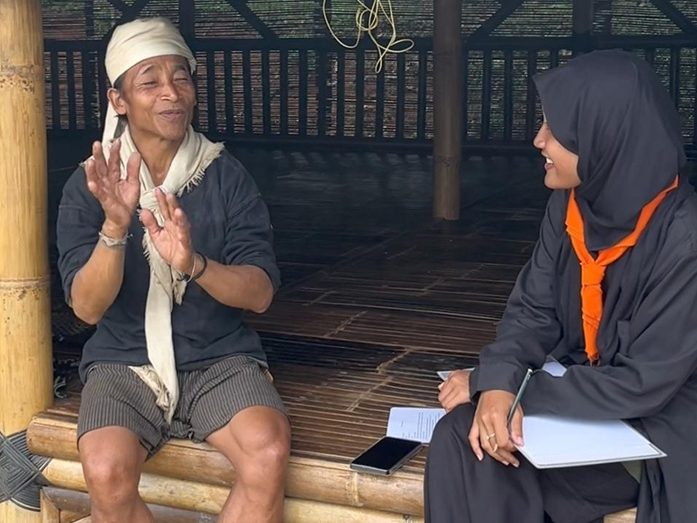
Bandung, August 24, 2025 — The Biocita Formica team from Universitas Pendidikan Indonesia (UPI) conducted research on tree-conservation strategies practiced by the Baduy Dalam community in Cijerenong Forest, Cibeo Village, Kanekes, Lebak Regency, from 20–24 August 2025. The study aimed to document the Indigenous community’s local knowledge regarding the preservation of their customary forest, or Leuweung Kolot, which has been sustainably maintained for generations.
The team departed from Leuwipanjang Terminal, Bandung, on Wednesday evening (20/8) and arrived in Saketi later that night. The following morning, they continued their journey to Binong for an initial interview with a key community figure and primary informant, Ayah Sangsang, who also served as their field guide. His son, Ayah Sayuti, accompanied the team throughout the research activities.
Using in-depth interviews and field surveys, the team explored conservation practices of the Baduy Dalam community. All activities followed local customary rules, including strict prohibitions on taking photos, recording videos, or capturing audio. These restrictions reflect the Baduy Dalam community’s deeply rooted respect for their customary territory and its documentation protocols.
Data collection continued until 23 August, after which the team traveled out of the customary area toward Baduy Luar on 24 August. The group arrived at the Ciboleger Gate around 14.00 WIB, marking the conclusion of their research activities.
Baduy community leader Ayah Sangsang emphasized that forest conservation principles are an inherent part of Indigenous identity.
“If only we protect the forest, we wouldn’t be strong enough. The forest is entrusted to us. If it is damaged, people will suffer,” he stated.
His remarks highlight the crucial role Indigenous communities play in maintaining ecological balance within forest areas.
Hawa, the project leader, noted that the visit to Baduy Dalam offered valuable insights into culturally rooted natural-resource use.
“Visiting Baduy Dalam was an invaluable experience. We learned that trees, leaves, and fruits are used not only for building materials but also for medicine and ritual needs,” she said.
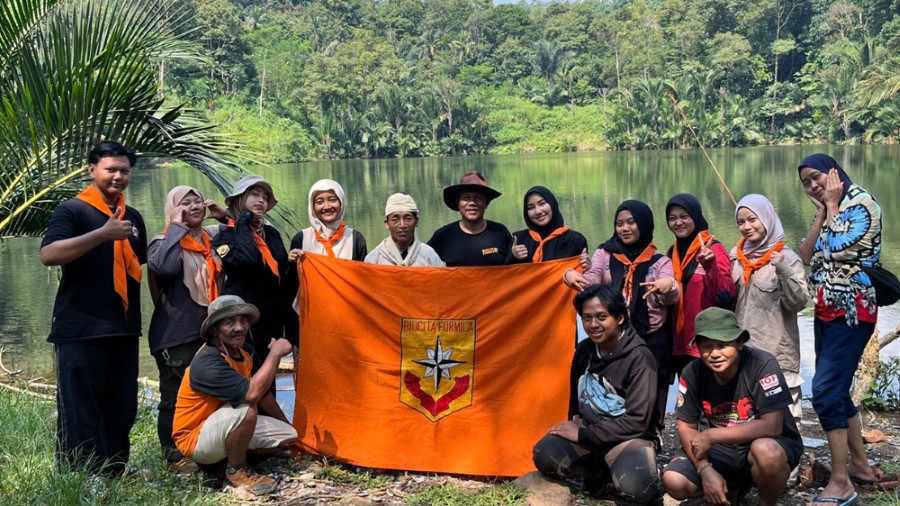
In addition to studying tree-conservation practices, the team gained a deeper understanding of the customary values that govern the community’s relationship with nature. The traditional saying “Gunung teu meunang dilebur, lebak teu meunang diruksak” (mountains must not be destroyed, lowlands must not be damaged) continues to serve as a moral foundation for environmental stewardship among the Baduy people.
Nabila Ramadhani, Head of KPA Biocita Formica, expressed her appreciation for the smooth execution of the research program.
“It was an excellent journey, and the trekking truly reflected a long-distance field experience. Keep learning and growing,” she encouraged.
Support also came from Kang Mamad, an alumnus from Biocita Formica’s first cohort, who mentored participants in technical preparation and overall implementation. He hopes the program will contribute meaningfully to students’ understanding of biological sciences.
This research forms part of Biocita Formica’s efforts to explore conservation concepts rooted in local wisdom. The findings are expected to enrich ethnobiological studies and encourage broader collaboration between academics and Indigenous communities in forest and biodiversity conservation. (Contributor)