



Bandung, UPI
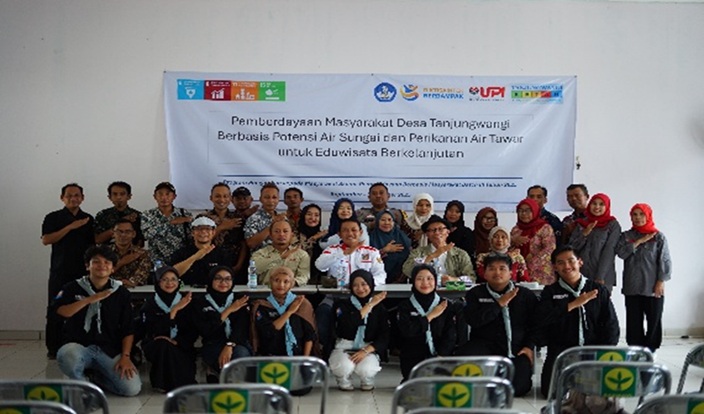
Universitas Pendidikan Indonesia (UPI) is strengthening its collaboration with Tanjungwangi Village, located in Cijambe District, Subang Regency, through the Community Partnership Program (Pengabdian Kemitraan Masyarakat/PKM) Batch III 2025. The initiative focuses on developing sustainable edu-tourism based on the village’s freshwater river and fisheries potential.
Funded by UPI and the Ministry of Higher Education, Science, and Technology, the program adopts an educational, participatory, and practical approach by involving key village stakeholders. These include BUMDes Betah Mandiri, the Tanjungwangi Village Government, Karang Taruna (youth organization), the Village Consultative Body (Badan Permusyawaratan Desa/BPD), PKK women’s group, and students from MAPACH FPIPS UPI. The program began in May 2025 with surveys and focus group discussions (FGDs), followed by intensive implementation from September through December 13, 2025.
Led by Dr. Asep Mahpudz, M.Si., alongside team members Prof. Dr. Karim Suryadi, M.Si., Dr. Acep Supriadi, M.Pd., M.AP, and Dr. Syaifullah, M.Si., the initiative is designed as a foundation for strengthening the village economy through locally driven resources.
“UPI is committed to delivering impactful community service by building village institutional capacity and integrating water resources, fisheries, and the environment into a unified sustainable edu-tourism model,” Dr. Asep Mahpudz stated.
The program includes a series of activities such as village potential mapping through FGDs, training in social entrepreneurship and village resource management, workshops on freshwater fish processing, and environmental action through the clean-up and revitalization of the 1.2-kilometer Cileuleuy Udik River. Additionally, simulation and trial runs of educational rafting were conducted as part of the edu-tourism development.
Tanjungwangi Village Head Budi Santoso, S.E. expressed appreciation for the collaboration, highlighting hopes for continued development. “We hope Tanjungwangi Village can grow into a leading edu-tourism destination based on river and freshwater fisheries, with ongoing support from UPI,” he said.
Support for the program’s sustainability was also emphasized by Prof. Dr. Cecep Darmawan, Dean of FPIPS UPI, who reaffirmed the faculty’s commitment to strengthening edu-tourism villages. This was further reinforced by Dr. Sandey Tantra Paramitha, M.Pd., Head of the Sustainable Community Service and Empowerment Division at UPI, who noted that future collaboration will be formalized through institutional partnerships between UPI and Tanjungwangi Village.
Meanwhile, Prof. Dr. Karim Suryadi, M.Si., stressed the importance of translating local water resource potential into tangible economic benefits for the community. “This program must continue to grow with support from local governments so that Tanjungwangi can become a model for water-based edu-tourism in Subang Regency,” he explained.
Moreover, through the PKM Batch III initiative, UPI contributes directly to the achievement of several Sustainable Development Goals (SDGs), including SDG 6: Clean Water and Sanitation, SDG 8: Decent Work and Economic Growth, SDG 11: Sustainable Cities and Communities, and SDG 15: Life on Land. By strengthening a village economy rooted in sustainable local potential, the program demonstrates how community-based innovation can drive both environmental stewardship and economic resilience. (Ajeng)