



Bandung, UPI
Learning is fundamentally not only about what teachers deliver, but also about what takes place in conversations between teachers and students.
A question can open up space for thinking. A response can encourage students to express their ideas. Even a simple instruction can shape how students understand and apply knowledge.
In the classroom, language is more than a means of delivering lessons. It is part of how knowledge is constructed, understood, questioned, and given meaning. This is where teacher talk becomes important: the way teachers speak can help students move beyond merely knowing something toward understanding, applying, and reflecting on it.
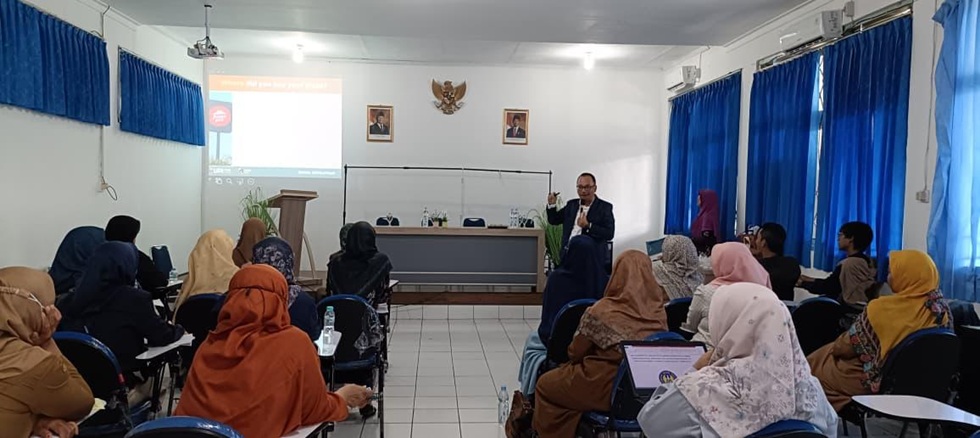
This idea provided the foundation for a Community Service Program (Pengabdian kepada Masyarakat or PkM) conducted by the Language and Culture Studies Expertise Group (KBK), English Language and Literature Study Program, Faculty of Language and Literature Education (FPBS), Universitas Pendidikan Indonesia (UPI), together with 30 junior high school teachers from Majalengka Regency.
The program carried the theme “Teacher Talk for Deep Learning: Supporting Students to Understand, Apply, and Reflect.”
The activity was held on Monday, June 22, 2026, at Universitas Majalengka (UNMA), from 9:00 a.m. to 3:00 p.m. WIB. The implementation team consisted of Riesky, M.Ed., Isti Siti Saleha Gandana, Ph.D., and Ernie D. A. Imperiani, M.Ed. The program was led by Riesky, M.Ed., with assistance from two final-year students, M. Aqil Dwipa Irsan Siregar and Laila Al-Farah.
The workshop invited participants to take another look at something very close to their everyday practice: the language they use when teaching. Discussions covered the use of questions and instructions, responses to students’ answers, and the provision of feedback.
Within this framework, teacher talk was not viewed merely as a means of delivering content or managing the classroom. Teachers’ language can create opportunities for students to think more deeply: to explain their reasoning, connect lessons with their experiences, apply knowledge in different contexts, and look back on the learning process they have experienced.
Bringing University Knowledge and Classroom Experience Together
Deep learning is not simply about how much material students are able to master. It also raises more fundamental questions: Do students understand what they have learned? Can they use it? And can they reflect on the meaning of the learning process itself?
In this context, classroom conversation becomes important.
Participants did not simply receive material from the facilitators. They were also invited to identify and map the types of questions and instructions they most frequently use in their everyday teaching practices. The workshop thus became a space to reconsider practices that may have been taking place automatically and to discover new possibilities for interaction with students.
The UPI team’s presence at UNMA was welcomed by UNMA Vice Rector III, Dr. Endi Rustadi, M.Pd.; Dean of the Faculty of Teacher Training and Education (FKIP) UNMA, Dr. Rama Dwika Herdiawan, M.Pd.; and Head of the English Education Study Program at UNMA, Afief Fakhruddin, S.S., M.Pd.
In his remarks, Dr. Endi Rustadi, M.Pd., emphasized the importance of collaboration between higher education institutions and school-based education practitioners. In his view, improving the quality of learning requires a space for dialogue between academic knowledge and teachers’ experiences in the classroom.
Such collaboration ultimately brings together two equally important elements of education: knowledge developed in universities and experience cultivated in classrooms.
Through this encounter, teacher talk becomes more than a question of how teachers speak. It becomes a question of how language can help students understand, use, and make meaning from knowledge.
Dr. Rama Dwika Herdiawan, M.Pd., Dean of FKIP UNMA, highlighted reflection as an important part of teachers’ professional development. According to him, teachers need to look back at the learning processes they have conducted in order to identify what has worked well and what can still be improved.
“Reflection is an important part of teacher professionalism. When teachers are willing to look back at what they have done, including aspects that have not worked optimally, they create space for improvement,” he said.
Mapping Teacher Talk
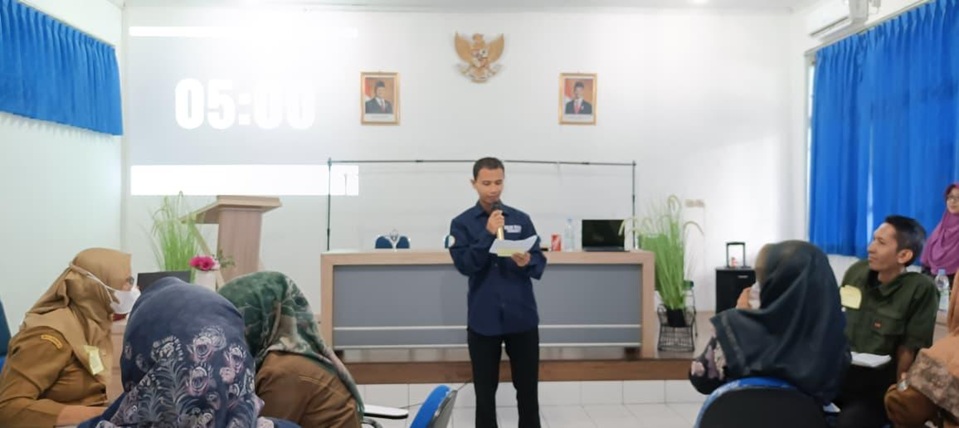
During the workshop, participants were asked to recall and write down the questions or instructions they most frequently use in their teaching activities. These examples were then mapped according to the learning opportunities they provide for students.
The mapping focused on three aspects: opportunities for students to understand, apply, and reflect on their learning.
According to Isti Siti Saleha Gandana, M.Ed., Ph.D., each form of teacher utterance can provide different learning opportunities. A question that asks students to recall information, for example, serves a different function from a question that asks them to explain their reasoning, connect knowledge with experience, or evaluate the learning strategies they have used.
Through this mapping process, participants found that teacher talk providing opportunities for students to reflect appeared less frequently than other types of questions or instructions.
This finding became a basis for discussion about why reflection has not received much space in everyday teaching practices. One issue discussed was the pace of teaching and learning activities, which often leads teachers and students to focus more heavily on completing the material and achieving learning targets.
Under such conditions, reflection can easily be overlooked.
Yet reflection allows students to look back at their learning experiences, identify difficulties, assess their progress, and determine what needs to be improved.
Reflection in Learning
The implementation team also connected the discussion of reflection with the ideas of John Dewey in Experience and Education (1938). Dewey positioned reflection as a process of looking back at experience and finding meaning in what has been done.
In learning, this principle can be applied by giving students opportunities not only to know the outcomes of their learning, but also to understand the process they have gone through.
Students can be encouraged to ask how they arrived at an answer, what difficulties they encountered, which strategies worked, and what they should do differently the next time.
Learning, therefore, does not stop at arriving at the correct answer. The learning process also involves the ability to look back at experience and learn from it.
The workshop further extended the idea of reflection to teachers’ own practices. When students are given opportunities to evaluate their learning, the feedback they provide may also concern the way teachers teach.
Students may point out that a teacher’s explanation was too fast, instructions were unclear, opportunities to ask questions were limited, or a particular activity was difficult to follow.
The implementation team encouraged teachers to view such feedback as information that can be used to evaluate the learning process.
Reflection does not mean that teachers must accept every criticism as the truth or blame themselves for every difficulty experienced by students. Rather, reflection means creating space to consider whether there are aspects of the learning process that can be improved.
Reflection as Part of Deep Learning
Afief Fakhruddin, S.S., M.Pd., Head of the English Education Study Program at UNMA, said that the theme of teacher talk has a direct connection with teachers’ everyday classroom practices.
“Teachers work in highly dynamic situations every day. Therefore, the ability to reflect on teaching practices is important. Teachers need to ask not only whether the material has been delivered, but also whether students have been given sufficient opportunities to think, apply what they have learned, and understand their own learning process,” he said.
Afief also expressed his hope that the activity would not end with the workshop itself, but would be implemented by teachers in their respective schools.
“We hope that this activity will not stop as a one-day workshop. The idea of reflection can continue to be brought into the classroom and developed according to the context of each school and the needs of its students,” he added.
For the implementation team, the discussion of teacher talk and reflection ultimately goes beyond teaching techniques. Reflection is also part of a learning process that enables both teachers and students to continually improve.
Teachers can reflect on the lessons they have conducted, while students can reflect on the learning processes they have experienced. Both can use the results of reflection as a basis for determining their next steps.
Through the PkM program, the Language and Culture Studies Expertise Group of the English Language and Literature Study Program, FPBS UPI, encouraged teachers to become more aware of their use of language in learning while providing greater opportunities for students to understand, apply, and reflect on what they learn.
Ultimately, learning may not simply be about how much students can remember or how accurately they can answer a question. There is something more fundamental: the ability to look back at what has been done, understand why something happened, and discover possibilities for moving forward in a better way.
This is where reflection acquires its meaning.
Teachers do not merely teach something to students; they also continue to learn from their teaching experiences. Students do not merely receive knowledge; they learn to understand how that knowledge is acquired and how the process shapes the way they think.
A question asked in class, an incorrect answer, an instruction that is not fully understood, and even the difficulties experienced by students can all become valuable learning experiences when they are examined again.
What matters is not that learning always takes place perfectly, but that every experience provides an opportunity to learn.
Reflection, therefore, is not merely an activity carried out during the final few minutes of a lesson. It is an attitude toward learning itself: a willingness to pause, look back at the journey that has been taken, and ask what can be learned from it.
Teachers and students, although occupying different positions, are actually engaged in the same process.
Both learn from experience. Both can change through what they experience. And both can use today’s learning as a foundation for doing something better tomorrow.
Perhaps this is ultimately what deep learning means: not merely knowing something, but understanding the experience behind knowledge, being able to use it, and developing the awareness to continue learning from it.