



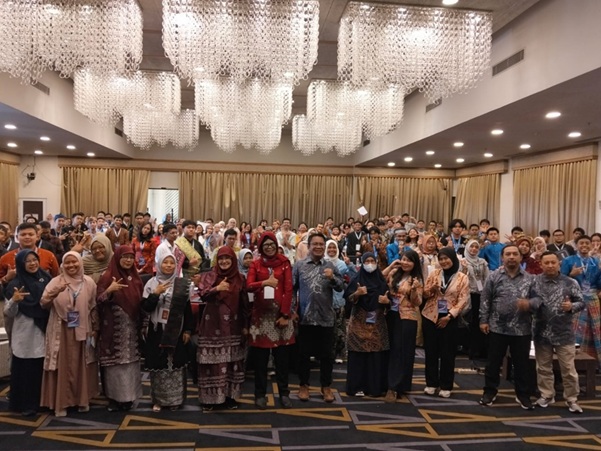
Bandung, UPI
Academic collaboration across leading universities continues to strengthen Indonesia’s national science ecosystem. Lecturers from Universitas Pendidikan Indonesia (UPI), Institut Teknologi Bandung (ITB), and Universitas Padjadjaran (Unpad) joined forces in organizing the Indonesia Physics Olympiad (OFI) 2026, held in Bandung from February 13 to 15, 2026.
Now in its fifth edition, OFI is a collaborative initiative between the Indonesian Scientific Society (ISS) and SEAMEO QITEP in Science. This year’s event also reflects a shared commitment to advancing the Sustainable Development Goals (SDGs), particularly SDG 4 (Quality Education), by promoting high-quality, inquiry-based science learning.
Growing Participation and Competitive Excellence
Since its inception in 2022, OFI has experienced consistent growth in participation. In 2026, a total of 243 high school students from 21 provinces registered for the competition. Following a rigorous selection process, 99 finalists from 10 provinces advanced to the Grand Final, which took place at Hotel De Java, Sukajadi, Bandung.
The academic integrity of the competition was upheld by a distinguished panel of judges, including:
- Prof. Bobby Eka Gunara (Physics, ITB)
- Dr. Selly Feranie (Physics, UPI)
- Dr. Kartika Hajar Kirana, M.Si. (Physics, Unpad)
Their involvement highlights the event’s strong academic foundation and national significance.
Innovative Assessment: Beyond Cognitive Testing
According to Doni Nurdiansyah, Head of OFI 2026, this year’s competition introduced an enhanced assessment format. In addition to traditional paper-based cognitive tests, participants were challenged through a case-study approach.
“This model not only measures conceptual understanding,” Doni explained, “but also evaluates problem-solving skills, creative thinking, scientific literacy, and argumentative communication.”
During the case study stage, participants were presented with randomly assigned problems covering theoretical physics, geophysics, and rock physics. They were allowed to consult scientific journals and references before formulating solutions and presenting them directly to the jury.
This approach mirrors authentic scientific practice, encouraging students to engage in deep, inquiry driven learning.
Physics as a Driver of Technological Advancement
At the closing ceremony on February 15, 2026, jury representative Dr. Selly Feranie emphasized the vital role of physics in technological development from subsurface exploration of the Earth to the study of the universe.
She also encouraged educators to integrate scientific articles and primary research sources into classroom teaching.
“This approach will help students become familiar with deep learning methods and develop the ability to conduct multidimensional analysis of complex problems,” she stated.
Nurturing Future Scientific Talent
Iwan Gunawan, Chair of the Indonesian Scientific Society (ISS), expressed high appreciation for all finalists. He noted that reaching the final stage reflects not only academic ability but also dedication, perseverance, and a strong commitment to science.
Through this synergy, UPI, ITB, and Unpad continue to play a strategic role in nurturing Indonesia’s next generation of scientific talent. The collaboration ensures that students are not only theoretically proficient but also adaptable and prepared to meet future technological challenges.
Conclusion: Advancing SDG 4 Through Collaboration
By combining rigorous academic standards, real-world problem-based assessment, and cross-institutional collaboration, OFI 2026 embodies the spirit of SDG 4 (Quality Education).
The initiative equips young scientists with the knowledge, skills, and mindset needed to contribute meaningfully to Indonesia’s scientific and technological progress ensuring a future generation that is both innovative and globally competitive.