



Bandung/Chirchiq, 14 April 2026
Universitas Pendidikan Indonesia (UPI) has once again reaffirmed its position as a leading education university in Asia through the scholarly contribution of UPI Professor Prof. Dr. Mohammad Ali, M.Pd., M.A., who served as a keynote speaker at the International Scientific-Practical Conference titled “Integration of Philological and Pedagogical Research in an Innovative Educational Environment” held at Chirchik State Pedagogical University (CSPU), the Republic of Uzbekistan, on 13–14 April 2026. Officially assigned by the Rector of UPI, Prof. Mohammad Ali represented UPI’s scholarly contribution at this cross-continental academic forum, which brought together scholars from Southeast Asia, Central Asia, Europe, and the United States.
This participation reinforces UPI’s role as an internationally recognized center for educational studies. As the only Indonesian representative invited as a keynote speaker, Prof. Mohammad Ali presented UPI’s distinctive scholarly framework, one that integrates modern pedagogical paradigms with language and literature research. The contribution also reaffirms the reputation of UPI’s study programs, particularly those focusing on educational studies, curriculum, and language education, as reference points for the development of innovative education in Asia.
A tangible outcome of UPI’s engagement in this forum is the opening of direct academic cooperation channels between UPI and CHDPU, as well as with strategic partners from Uzbekistan, Kazakhstan, Malaysia, and the United Kingdom. The forum provides space for UPI’s study programs to explore joint research, faculty and student exchange, and joint curriculum development that enriches the implementation of the Tridharma of Higher Education. For UPI’s academic community, this achievement also serves as a gateway to internationalizing academic programs at the faculty and program levels, particularly through the development of innovative language learning and pedagogy.
Prof. Mohammad Ali’s presence in Uzbekistan aligns with the spirit of Diktisaintek Berdampak, the Ministry of Higher Education, Science, and Technology (Kemdiktisaintek) ‘s policy orientation that positions higher education, science, and technology as the engine for generating real-world impact in society. Rather than stopping at ceremonial participation, this academic diplomacy produces measurable impact through strengthened faculty capacity, the exchange of scholarly ideas, and the opening of international collaboration spaces that will be translated into academic programs at the faculty and study-program levels. This aligns with Diktisaintek Berdampak’s direction, which encourages UPI to continue producing research, innovation, and international cooperation that are both relevant to the needs of Indonesian society and that contribute to global civilization.
UPI’s participation in this international conference also contributes to the achievement of the Sustainable Development Goals (Sustainable Development Goals/SDGs), particularly SDG 4 (Quality Education) through the strengthening of cross-country research and learning innovation, as well as SDG 17 (Partnerships for the Goals) through inter-university cooperation networks across Southeast Asia, Central Asia, and Europe. The integration of philology and pedagogy, the conference theme, is also relevant to SDG 10 (Reduced Inequalities), as it encourages equitable access and quality in education through learner-centered approaches and the preservation of heritage languages.
Building on these impacts, UPI views this participation as having multi-layered strategic significance and generating several follow-up recommendations. First, the presence of a UPI professor as a keynote speaker reaffirms UPI’s reputation as a leading educational institution in Asia. It should be followed up by strengthening sustained academic diplomacy. Second, this forum opens direct cooperation channels with Uzbek universities, connections that have so far remained underdeveloped among Indonesian higher education institutions. Third, meetings with delegations from Malaysia, Kazakhstan, and the United Kingdom expand opportunities for multilateral research collaboration, making it advisable to develop faculty and student mobility programs and joint conferences as strategic, long-term follow-ups.
Integrating Philology and Pedagogy for Innovative Education
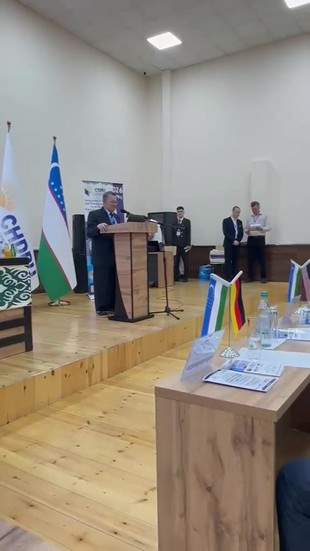
Prof. Mohammad Ali delivers the keynote address to participants of the International Scientific-Practical Conference at Chirchik State Pedagogical University, Uzbekistan, 13 April 2026.
Carrying the theme of integrating philological and pedagogical research, the conference affirmed the relevance of interdisciplinary collaboration in building an educational ecosystem that is adaptive to the demands of the 21st century. The organizers emphasized that philological studies deepen understanding of language, communication, and culture. In contrast, pedagogical studies develop effective learning methods, and the two must converge to produce learner-centered, innovation-oriented educational approaches.
On 13 April, Prof. Mohammad Ali delivered the plenary session at 10.00–10.30 Chirchiq time, with a presentation titled “Integration of Philological and Pedagogical Research in an Innovative Educational Environment: Concept and Application”. In addition to the plenary session, he also led a workshop session on the same day.
In his presentation, Prof. Mohammad Ali positioned philological research, which examines language, literature, and texts, and pedagogical research, which studies teaching and learning processes, as two fields whose integration is a prerequisite for designing innovative educational environments. Drawing on a pragmatic paradigm with a mixed-methods approach (mixed-methods), he emphasized that the strengths of postpositivist and constructivist traditions can complement one another when philology and pedagogy are brought together within a single dialogical framework. The presentation then mapped five concrete areas of integration: language-teaching methodology, critical thinking development, multimodal literacy, heritage-language preservation, and the use of artificial intelligence and digital humanities, complete with illustrations ranging from corpus-based academic writing instruction to AI-assisted literary analysis. In closing, Prof. Mohammad Ali offered a series of strategies interdisciplinary research team collaboration, curriculum co-design, technology integration, teacher training, and action research (action research) that universities can adopt to transform the way 21st-century learners engage with language and literature.
Program, Organizers, and Attending Officials
The conference was organized by the Department of English Language Theory and Practice, together with the Interfaculty Foreign Languages Department of the Faculty of Tourism at CHDPU, under the auspices of the Ministry of Preschool and School Education of the Republic of Uzbekistan. All sessions were held in the Conference Hall on the first floor of University Building No. 3, Faculty of Tourism, CHDPU, Chirchiq City, Tashkent Province.
Prof. Mohammad Ali’s assignment was formalized through the UPI Rector’s Letter of Assignment No. 2218/UN40/RT.02.01/2026 dated 26 March 2026, signed by the Rector of UPI, Prof. Dr. Didi Sukyadi, M.A. The host fully bore all activity costs. The formal invitation as keynote speaker was extended directly by the Rector of CHDPU, Prof. Muxamedov Gafurdjan Israilovich, Doctor of Chemical Sciences and Distinguished Scientist of Uzbekistan.
The plenary speakers featured a roster of scholars from multiple countries, including Dr. Komila Tangirova, Dr. Zulfiya Tuxtaxodjayeva, and Dr. Gulnara Maxkamova (Uzbekistan National Pedagogical University), Dr. Giuseppe Chiaramonte, Dr. Sabariah Binti Sulaiman, and Dr. Timur Pak. The conference also engaged several global strategic partners, including Universiti Pendidikan Sultan Idris (Malaysia), Auezov University (Kazakhstan), and the University of Warwick (United Kingdom).
Academic Diplomacy to the Heart of Central Asian Civilization
Amid the series of academic activities in Uzbekistan, Prof. Mohammad Ali also paid a courtesy call to the Ambassador of the Republic of Indonesia to the Republic of Uzbekistan, concurrently accredited to the Kyrgyz Republic, Prof. Dr. Hj. Siti Ruhaini Dzuhayatin, M.A., at the Embassy of the Republic of Indonesia in Tashkent. In this warm meeting, Ambassador Siti Ruhaini described Uzbek society as naturally pluralistic and highly open to other cultures, as reflected in the diverse ethnicities coexisting there, including Uzbek, Tatar, and Russian, as well as traces of Macedonian heritage. Indonesia shares a similar disposition toward openness, placing the two countries in a strategic position to jointly present a moderate, open, peaceful, and rahmatan lil alamin (a mercy to all creation) face of Islam amid a world currently marked by conflict. The Ambassador further introduced Uzbekistan and the Central Asian region as the New Continent. This region has completed its political consolidation and is now advancing toward comprehensive development, accompanied by a rising middle class and the development of natural and human resources, all of which open significant opportunities for Indonesia to build an equal and mutually beneficial partnership in the spirit of family. In response, Prof. Mohammad Ali underscored the importance of broadening cooperation not only in education, economy, and socio-cultural affairs, but also in science and technology, as a tangible manifestation of UPI’s academic diplomacy working in synergy with Indonesia’s diplomatic mission at the heart of Central Asian civilization.
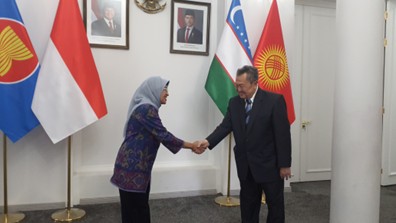
Prof. Mohammad Ali is received by the Ambassador of the Republic of Indonesia to the Republic of Uzbekistan, concurrently accredited to the Kyrgyz Republic, Prof. Dr. Hj. Siti Ruhaini Dzuhayatin, M.A., at the Embassy of the Republic of Indonesia in Tashkent, 13 April 2026.
The program did not end in the conference hall. On 14 April, speakers and delegates were taken on an academic-cultural visit to Samarkand, one of the classical centers of Islamic scholarly civilization. The delegation visited Registan Square, the Shah-i-Zinda mausoleum complex, and Gur-e-Amir, before returning to Chirchiq in the afternoon. The visit reaffirmed Uzbekistan’s position as a historical meeting point between Eastern and Western scholarly traditions.
Prof. Mohammad Ali’s participation in the Chirchiq conference marks an important milestone in UPI’s journey toward becoming a world-class education university. Grounded in Diktisaintek Berdampak and committed to achieving the SDGs, UPI hopes that similar activities will continue to be replicated by its professors and lecturers, so that UPI’s scholarly contribution will be felt not only in Indonesian education but also across the global education landscape.
(Contributors: Diemas Arya Komara and Angga Hadiapurwa)