



Bandung, UPI
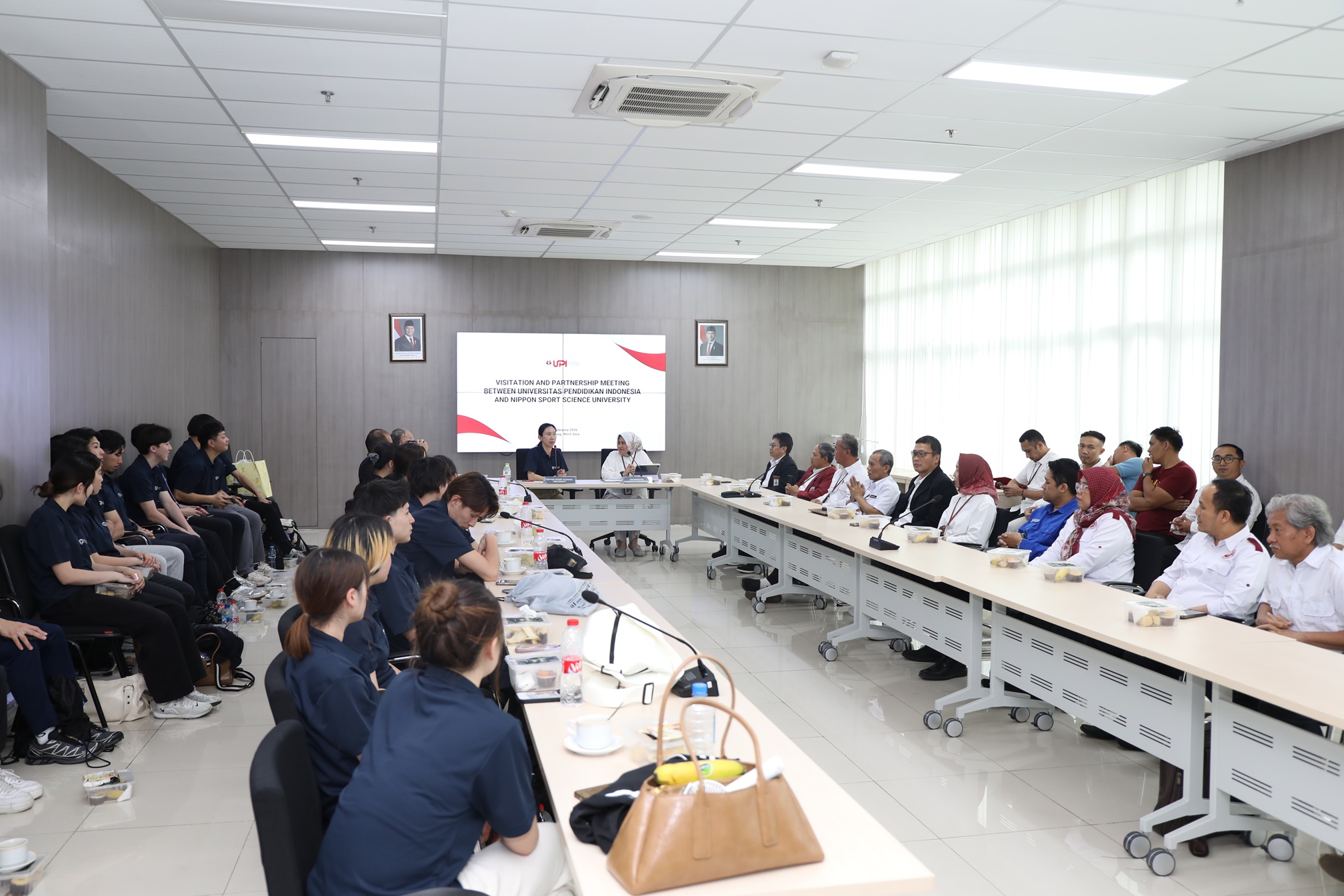
Universitas Pendidikan Indonesia (UPI) continues to expand its global network through a visit from a delegation of Nippon Sport Science University (NSSU), Japan. This visit builds on a long standing partnership that is now being developed into more concrete collaborations in education, sports, and cultural exchange. The event took place at the DSTI Meeting Room on the 1st Floor of the PPG Building, Jl. Dr. Setiabudhi No. 229, Bandung, on Monday (January 2, 2026).
Prof. Vanessa Gaffar, S.E. Ak., MBA., Vice Rector for Education and Quality Assurance at UPI, explained that during the visit, NSSU delegates conducted live teaching practice at UPI’s Lab School as part of applied academic collaboration. The program also involved the Physical Education, Health, and Recreation (PJKR) Study Program and the Faculty of Sport and Health Education (FPOK), where participants engaged in academic discussions and shared learning experiences.
Beyond academics, the visit also highlighted cultural exchange through demonstrations of traditional games from both Indonesia and Japan. This hands-on interaction emphasized that cultural learning is most meaningful when experienced directly, rather than only through books or digital media.
Looking ahead, both institutions hope to expand the scope of this collaboration. “We expect this partnership to go beyond visits and teaching practice,” she said. “There is a shared commitment to develop broader initiatives, including two-way student exchanges, joint research, collaborative publications, as well as faculty and professor exchanges.”
Through this partnership, UPI reaffirms its commitment to strengthening the internationalization of education and enhancing the quality of the tridharma of higher education through continuous global collaboration.
This initiative supports SDG 4 (Quality Education) by promoting innovation in teaching and international academic exchange, SDG 3 (Good Health and Well-Being) through the advancement of physical education and sports, and SDG 17 (Partnerships for the Goals) by fostering cross-border academic and cultural collaboration. (Rija/DN)