



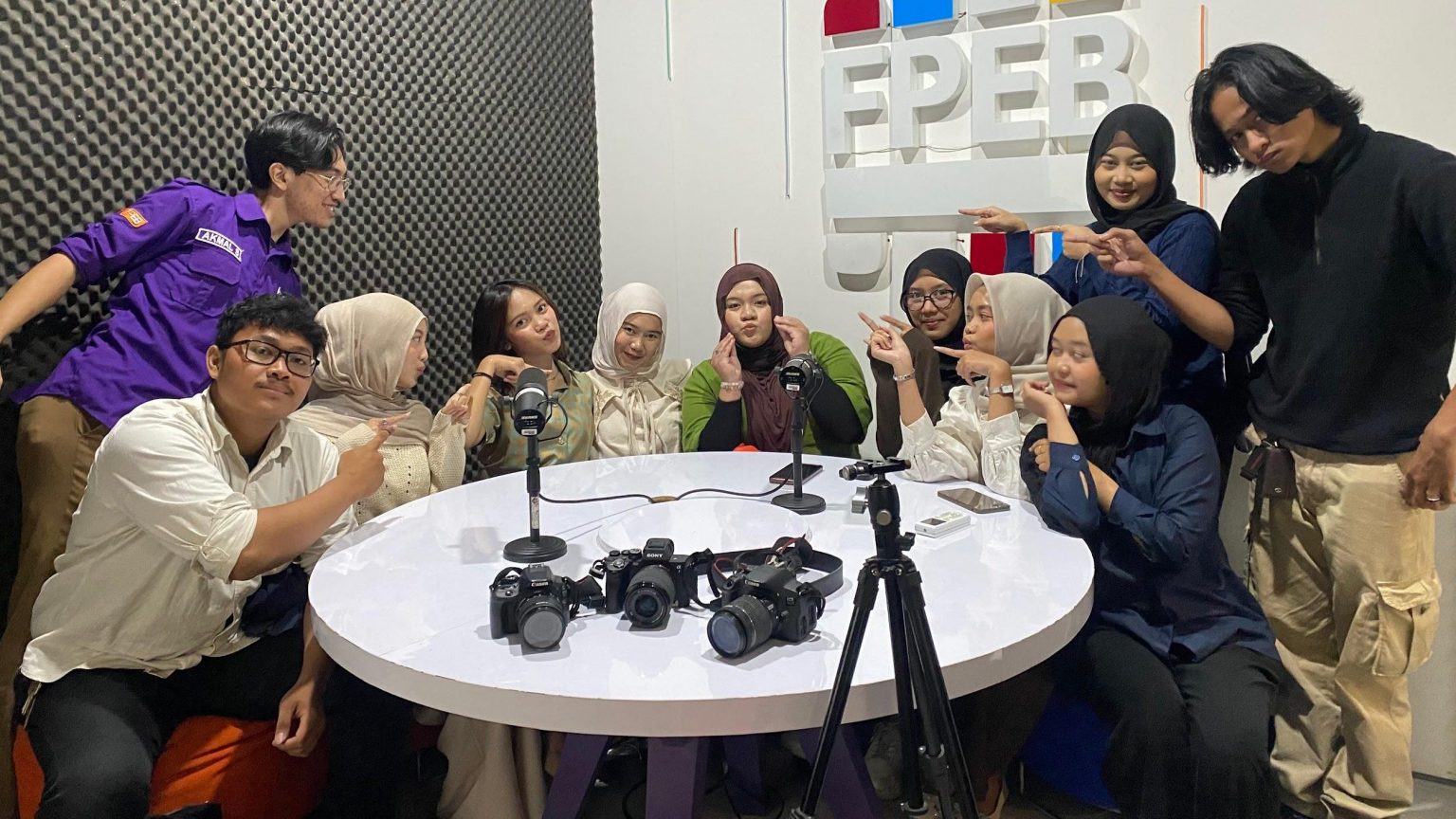
Bandung, UPI
The Business Education Student Association (BESA) of Universitas Pendidikan Indonesia (UPI) has introduced BE Podcast as a digital educational media program aimed at students. This initiative represents one of BESA UPI’s innovations in utilizing digital platforms as a space for discussion and non-formal learning.
BE Podcast is presented in an audio-visual format and broadcast online. The program explores various topics related to student life, self-development, organizational involvement, and readiness to face both academic and professional worlds.
Over the past year, BE Podcast has released four episodes with interconnected themes. The first episode, titled “Students Are Not Just About Campus Life: Time to Be Active and Empowered,” featured Mira Putri Aulia, a Universitas Pendidikan Indonesia student, who discussed the importance of student engagement in developing personal potential beyond academic activities.
The second episode, “College, Creativity, and Anxiety: Strategies for Surviving in a Fast-Paced Era,” featured Sheryl Ghefira, also a UPI student, who examined the realities of anxiety commonly experienced by students and shared strategies to remain productive and adaptable.
In the third episode, titled “Networking, Leadership, Empathy: The Added Value of Student Organizations,” BE Podcast invited Nur Iman Gunawan and Nazha Aulia Meytun, UPI students, to share their experiences on the role of student organizations in building networks, leadership skills, and social awareness.
Meanwhile, the fourth episode, “Becoming a Teacherpreneur: Challenges and Opportunities in Integrating Business Education Graduates’ Competencies as Educators and Entrepreneurs,” featured Asep Ridwan Lubis, S.Mat., MvBA, a lecturer from the Faculty of Economics and Business Education (FPEB) UPI. In this discussion, he highlighted opportunities to strengthen entrepreneurial competencies among education students without neglecting their primary role as educators.
Through BE Podcast, BESA UPI offers an alternative digital learning space that is communicative and easily accessible to students from diverse backgrounds.
Importantly, the initiative relates to SDG 4: Quality Education through the development of accessible digital learning platforms, SDG 9: Industry, Innovation and Infrastructure by utilizing digital media as an innovative educational tool, and SDG 10: Reduced Inequalities by providing inclusive learning opportunities for students from diverse backgrounds. (Ajeng)