



BANDUNG BARAT, UPI
Evening falls fast in Fatima’s corner of the world. When the sun slips behind the pine forest that wraps around Mekarsari Village in Rongga Sub-district, West Bandung Regency, the darkness that follows used to be total. For more than fifteen years, this family of four knew only the faint, flickering glow of a damar oil lamp or a candle to see by. Now, for the first time, a steady light burns in their home every night.
That light comes from a small solar panel — installed free of charge by Universitas Pendidikan Indonesia as part of a community empowerment programme — and for Fatima, her husband, and their two children, it has changed almost everything.
“Alhamdulillah, now we have light. The children can study at night,” she says, a quiet smile on her face.
A University Reaches Into the Forest
On Saturday, 14 March 2026, a delegation from Universitas Pendidikan Indonesia made the journey to Mekarsari Village, led by UPI Rector Prof. Dr. H. Didi Sukyadi, M.A., who came in person to see the impact of the university’s solar energy initiative on the ground.
The visit was part of UPI Berdampak LIMAR — short for Listrik Mandiri Rakyat (People’s Independent Electricity) — a public service programme designed to extend energy access to households that have been left behind by the national electricity grid. The programme installs solar panels on the homes of low-income families who lack any reliable source of lighting.
Beyond checking on panels already in use for several months, the team installed new units at the homes of two additional families that day. The programme positions solar technology as a practical and scalable solution for remote communities in Indonesia, where geography and poverty continue to leave millions without access to basic energy infrastructure.
A 4×4 Metre World Without Electricity
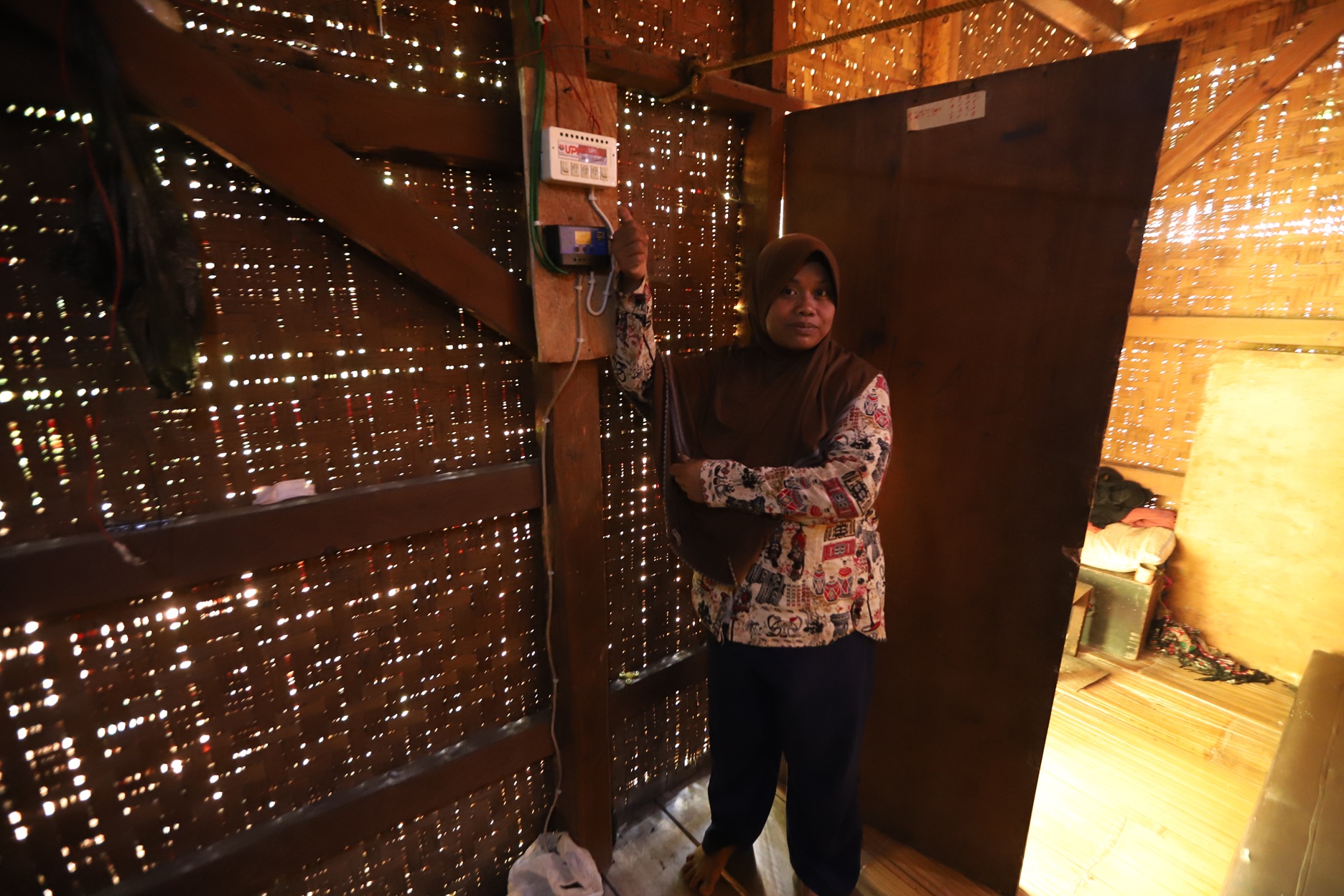
Reaching Fatima’s home requires a walk along a steep forest path. The house itself , a modest raised structure measuring roughly four by four metres, sits in the hush of pine trees, its walls woven bamboo, its floors worn wooden planks. In the kitchen, the floor is bare earth, and a wood-fired stove is used for every meal.
In the small yard beside the house, four goats borrowed from neighbours graze in a simple enclosure. Tending them is one of the few ways the family supplements their income. Fatima’s husband works as a pine resin tapper in the surrounding forest, seasonal, unreliable work whose earnings drop sharply when the rains come.
Their two children — a 13-year-old daughter in her second year of junior secondary school, and a six-year-old son just starting primary school — grew up doing their homework only by daylight.
“At night we used the damar lamp or candles. The children could only really study during the day,” Fatima says. The dim flame was never bright enough for reading, so the books stayed closed after sunset.
How the Sun Stays On All Night
The solar panel at Fatima’s home works simply. Throughout the day, the panel absorbs sunlight and stores the energy in a battery. After dark, that stored power feeds the lamps inside; steady, quiet, reliable.
It is a modest system by most standards: enough to run a few lights and charge a mobile phone. But in a home that had nothing, it is transformative. The family’s evenings have been rewritten.
“The children can study at night now, and they can read the Qur’an too,” Fatima says. A lamp was also installed at the front of the house, so the small yard no longer vanishes into darkness, and Fatima no longer needs a torch just to step outside.
The system does have its limits. During extended periods of cloudiness or rain, the battery drains faster, and the family rations its use.
“When the weather is overcast we only switch on two lamps at a time so the power lasts longer,” she explains. But across several months of use, the panel has performed reliably. “Alhamdulillah, it has worked well — no problems at all.”
Light Is Just the Beginning
Even with electricity now in the house, daily life in Rongga remains hard. Clean water is the next urgent need. The nearest water source is a difficult walk away, along a path that turns treacherous in the wet season. A recent landslide of bamboo briefly cut off access to the water supply entirely.
“My hope now is that there will be help with clean water access,” Fatima says. She wants the day to come when she does not have to walk that distance simply to fetch water for her family.
She also took a moment to express her gratitude directly to the institution that changed her nights. In her native Sundanese, she offered words that translate roughly as:
“We give a thousand thanks to UPI and to the Rector, who have helped our home have its own electricity, so that at night, the children can study because it is now bright.”
A Tiny Flame, A Larger Story
In every city in Indonesia — and across the developed world — electric light is invisible in its ordinariness. It is flicked on without thought and taken for granted entirely. In Mekarsari Village, that ordinary thing is an act of transformation.
The light in Fatima’s home is not powerful. But it is enough for a 13-year-old girl to open her textbook after dinner. Enough to make the walk to the front door safe. Enough to make the future feel, in some small but real way, closer.
In the quiet of the pine forest, a solar panel no bigger than a window is doing the quiet, steady work of equity.