




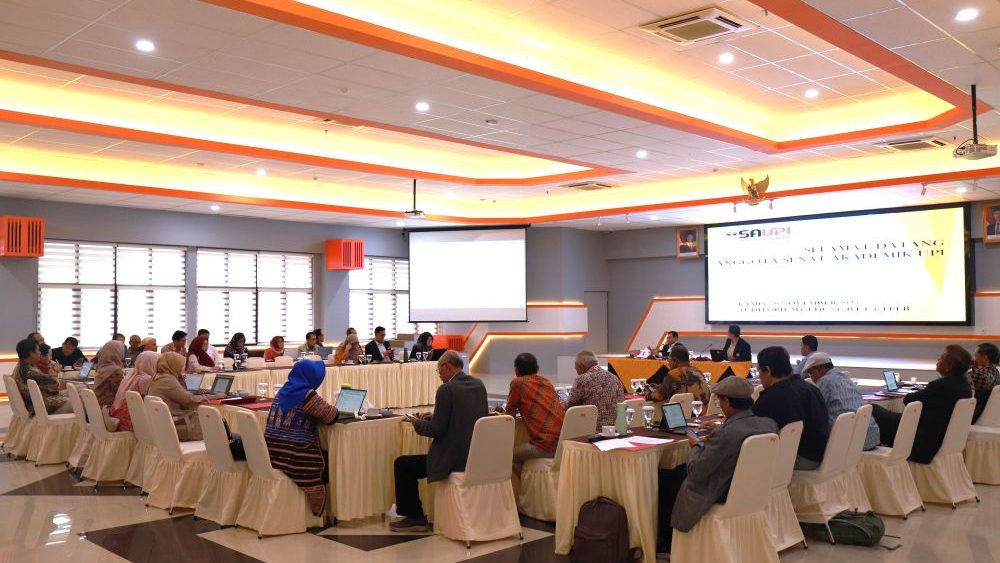
Bandung, November 20, 2025 — The Academic Senate of Universitas Pendidikan Indonesia (UPI) held its 11th Plenary Meeting at the Auditorium of the Faculty of Economics and Business Education (FPEB) on Thursday (20/11/2025). This strategic session centered on an in-depth review of the university’s quality standards and the formulation of UPI’s Development Direction for the 2025–2030 period under the leadership of the newly appointed rector.
The plenary meeting was attended by university leaders, including UPI Rector Prof. Dr. H. Didi Sukyadi, M.A., the Vice Rectors for Education and Quality Assurance, Resources and Information Systems, and Student Affairs, Alumni, and Business, as well as all members of the Academic Senate.
Chair of the UPI Academic Senate, Prof. Dr. Yadi Ruyadi, M.Si., explained that the Senate now convenes more frequently—nearly every month—despite ministerial regulations requiring plenary meetings at least once every three months.
“There are indeed many important matters that must be discussed and resolved by the Senate,” Prof. Yadi noted, referring to the wide range of essential agendas requiring careful examination.
During this 11th plenary session, several key UPI standards were reviewed in detail. However, Prof. Yadi stated that the Senate is not yet ready to issue final considerations.
“These will be returned to the relevant commissions for further discussion and additional input,” he said.
In addition to evaluating standards, the Senate also provided insights on the university’s development direction for the next five years—the rector’s term of office. UPI’s development priorities are outlined in the 2025–2030 Strategic Plan (Renstra), which is aligned with the university’s five-year strategic framework and implemented under the guidance of the current rector.
Prof. Yadi further emphasized that the university’s development efforts must refer to the Key Performance Indicators (IKU) set by the Ministry of Education, Culture, Research, and Technology. These indicators function as a performance agreement between the rector and the minister, and must be achieved optimally.
“The Ministry will later compare UPI’s achievements with those of other PTNBH institutions based on performance levels,” he explained.
Regarding priorities, Prof. Yadi stressed that all IKUs are equally important, as universities are obligated to fulfill all aspects of the Tri Dharma of Higher Education: education and teaching, research, and community service.
“In addition, university governance must also be well-managed,” he added.
The 11th Plenary Meeting of the UPI Academic Senate reaffirms the university’s commitment to strengthening quality assurance, governance, and competitiveness amid the growing demands placed on State Universities with Legal Entity (PTNBH) status. (Contributor)