



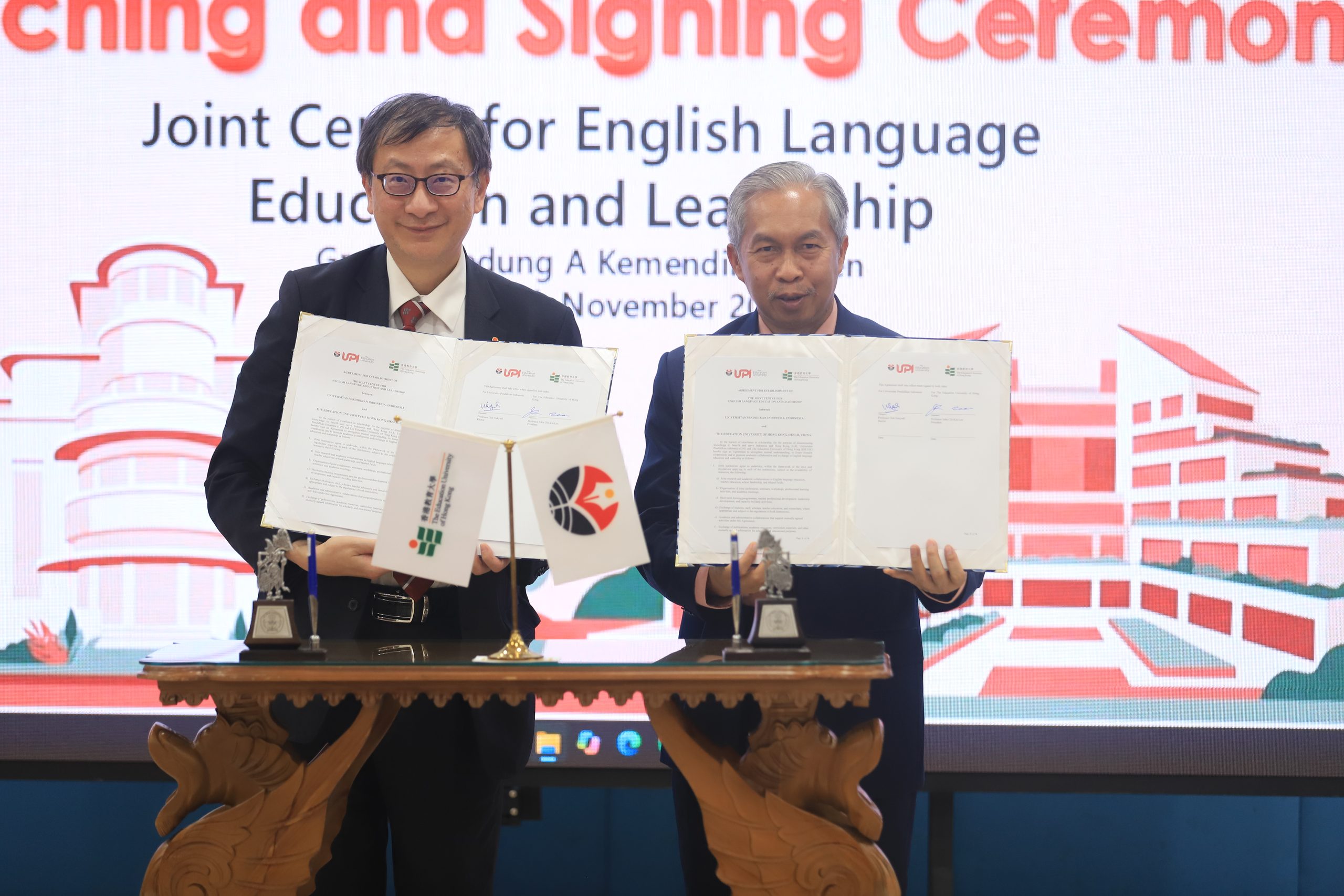
Jakarta, UPI
In preparation for the introduction of English as a compulsory subject in primary schools from the 2027/2028 academic year, Universitas Pendidikan Indonesia (UPI) and The Education University of Hong Kong (EdUHK) have launched the Joint Centre for English Language Education and Leadership. The centre was formally established through the signing of a cooperation agreement at Indonesia’s Ministry of Primary and Secondary Education in Jakarta on Thursday, 5 November 2026. It is designed to improve teachers’ competencies, develop teaching materials, and advance educational leadership through data-driven research and development.
The establishment of the centre represents one of UPI’s contributions to addressing the challenges of implementing the national policy on English language education in primary schools. Implementing the policy will require teachers to have not only English language proficiency but also the pedagogical competencies needed to teach a foreign language in ways that are appropriate to learners’ developmental stages.
Under Minister of Primary and Secondary Education Regulation No. 13 of 2025, English, previously an elective subject, will become compulsory in primary schools (SD), Islamic primary schools (MI), and equivalent institutions from the 2027/2028 academic year. This policy change requires schools to be adequately prepared, particularly in terms of teacher availability and competence.
The Ministry of Primary and Secondary Education has implemented the Competency Development Programme for Primary School Teachers Teaching English (PKGSD-MBI), which targets 90,447 schools. In the programme’s initial phase in 2026, 5,777 teachers from 34 provinces and 177 regencies and cities participated in training. On 5 November 2026, Minister of Primary and Secondary Education Prof. Dr. Abdul Mu’ti, M.Ed., reported that 58,482 primary school teachers had participated in training under the programme, which involved 101 higher education institutions.
In his remarks at the launch of the Joint Centre, Abdul Mu’ti emphasised that improving teachers’ competencies is an essential part of preparations to introduce English language instruction in primary schools. The government aims to ensure that teachers have the competencies needed to implement the policy as planned.
He noted that the partnership between UPI and EdUHK is strategically significant because it can support the government’s efforts to prepare competent educators. He also expressed hope that the institutional partnership would lead to sustained programmes rather than remain a one-time agreement-signing exercise.
UPI Rector Prof. Dr. H. Didi Sukyadi, M.A., stated that UPI, as a university with expertise in education, has a responsibility to contribute to meeting this national need.
“The government has a very ambitious plan to introduce English lessons for Grade 3 primary school pupils. However, the challenge is that most schools currently do not have specialist English teachers, and much of the teaching is still handled by classroom teachers. UPI therefore believes it has the capacity to contribute to and support this change,” he said.
Didi explained that the Joint Centre would focus on three main areas: developing teaching materials tailored to the needs of primary-school English instruction; providing teacher training and competency development; and conducting research and development to evaluate teaching effectiveness and monitor learners’ progress.
To carry out these activities, UPI will draw on the academic expertise of its Faculty of Language and Literature Education (FPBS) and the academic support of EdUHK to develop learning and training materials suited to Indonesia’s educational context. The work will also draw on educational practices in Hong Kong as references for adaptation to the Indonesian context.
Alongside training, research will play an important role in measuring programme outcomes. With support from artificial intelligence (AI), the centre will develop tools to monitor learners’ progress regularly. This monitoring is expected to provide information on teaching effectiveness over time, enabling data-informed improvements rather than requiring stakeholders to wait until the end of the programme for an evaluation.
UPI has also allocated space within FPBS for the centre, designated an academic team to manage its activities, and planned funding support through the university’s internal research funding scheme.
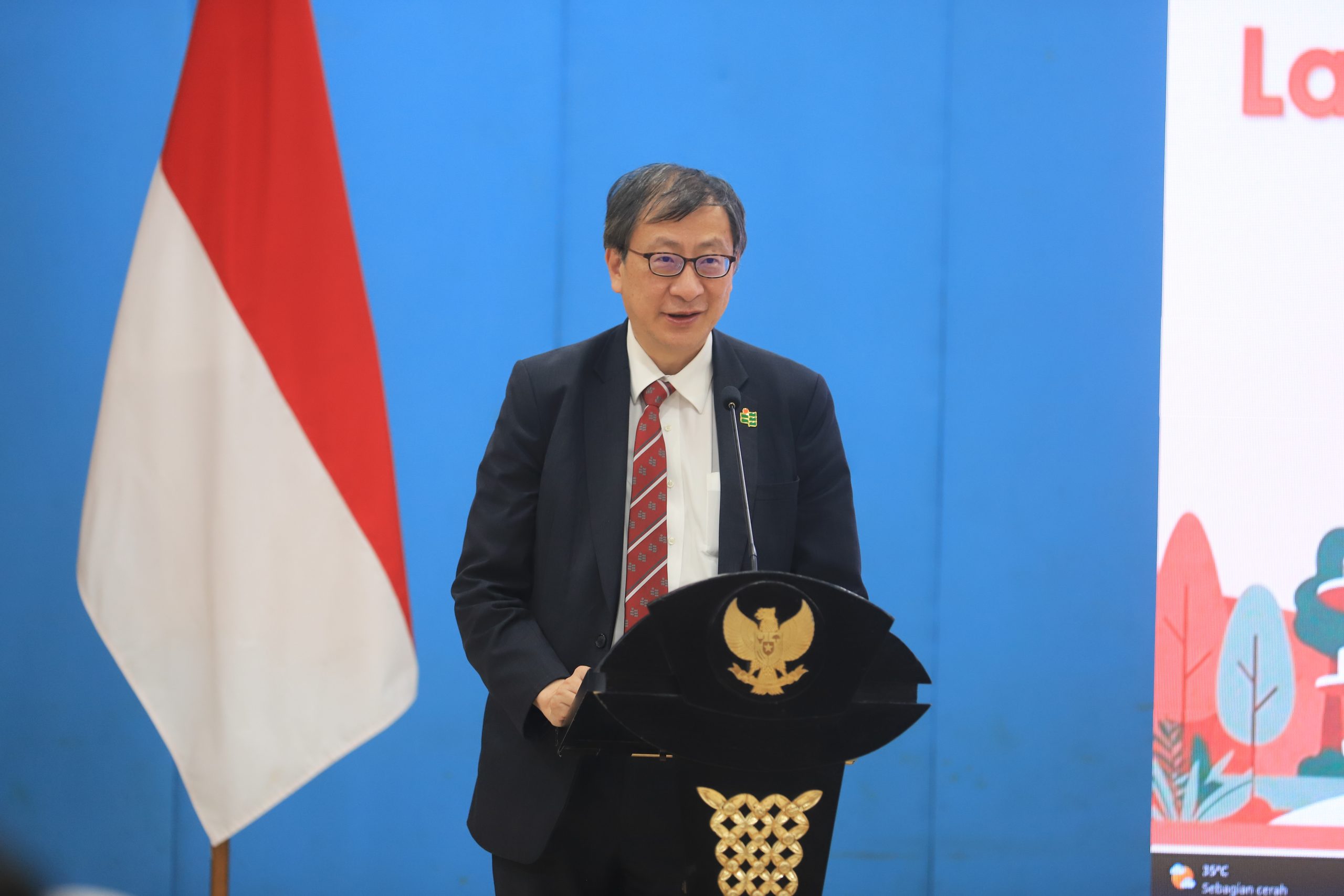
EdUHK President Prof. John Lee Chi-Kin, JP, stated that the collaboration would bring together the two universities’ experience and expertise in English language education, curriculum development, and educational leadership.
“Through this Joint Centre, we hope to combine the experience and strengths of both universities to advance English language education, develop educational leadership, and create more opportunities for educators and learners,” he said.
John Lee explained that the development of English language education needs to be supported by three dimensions of leadership: system leadership, school leadership, and subject leadership. These refer to leadership at the education-system, school, and subject levels and are intended to connect policy implementation with classroom practice.
He added that the two universities would conduct joint research, share experiences, and exchange evaluation findings to support the development of English language education programmes in Indonesia.
The need to improve teachers’ competencies is also evident in several primary schools in Bandung included in UPI’s preliminary mapping. The Dean of FPBS UPI, Prof. Wawan Gunawan, M.Ed., Ph.D., explained that the schools were selected to represent different levels of learning achievement, including high-, middle-, and lower-performing schools. Wawan added that the mapping would provide a basis for identifying schools’ actual needs before learning materials and teacher training programmes are developed.
Ihat Solihat, principal of SDN 196 Sukarasa in Bandung, explained that English at her school is currently taught by classroom teachers because the school does not have a dedicated English teacher.
“At our school, English is taught by classroom teachers. Since they do not specialise in English, instruction remains limited. We hope this partnership will provide teachers with training to improve their professional competence, so that pupils can develop not only their vocabulary but also their speaking and listening skills, as well as their ability to understand written English,” she said.
Through the establishment of the Joint Centre for English Language Education and Leadership, UPI is contributing its educational expertise, research capacity, and human-resource development capabilities to support the implementation of national education policy. The centre’s activities will be carried out in stages through the preparation of teaching materials, teacher training and mentoring, joint research, and ongoing evaluation of teaching and learning.
The outcomes of these activities are expected to provide evidence-based input for improving the quality of English language teaching in primary schools. Preparations for the introduction of compulsory English in the 2027/2028 academic year will therefore address not only curriculum implementation but also teacher readiness, the quality of teaching and learning, and equitable learning opportunities for pupils across Indonesia. (RK)