



Bandung, UPI
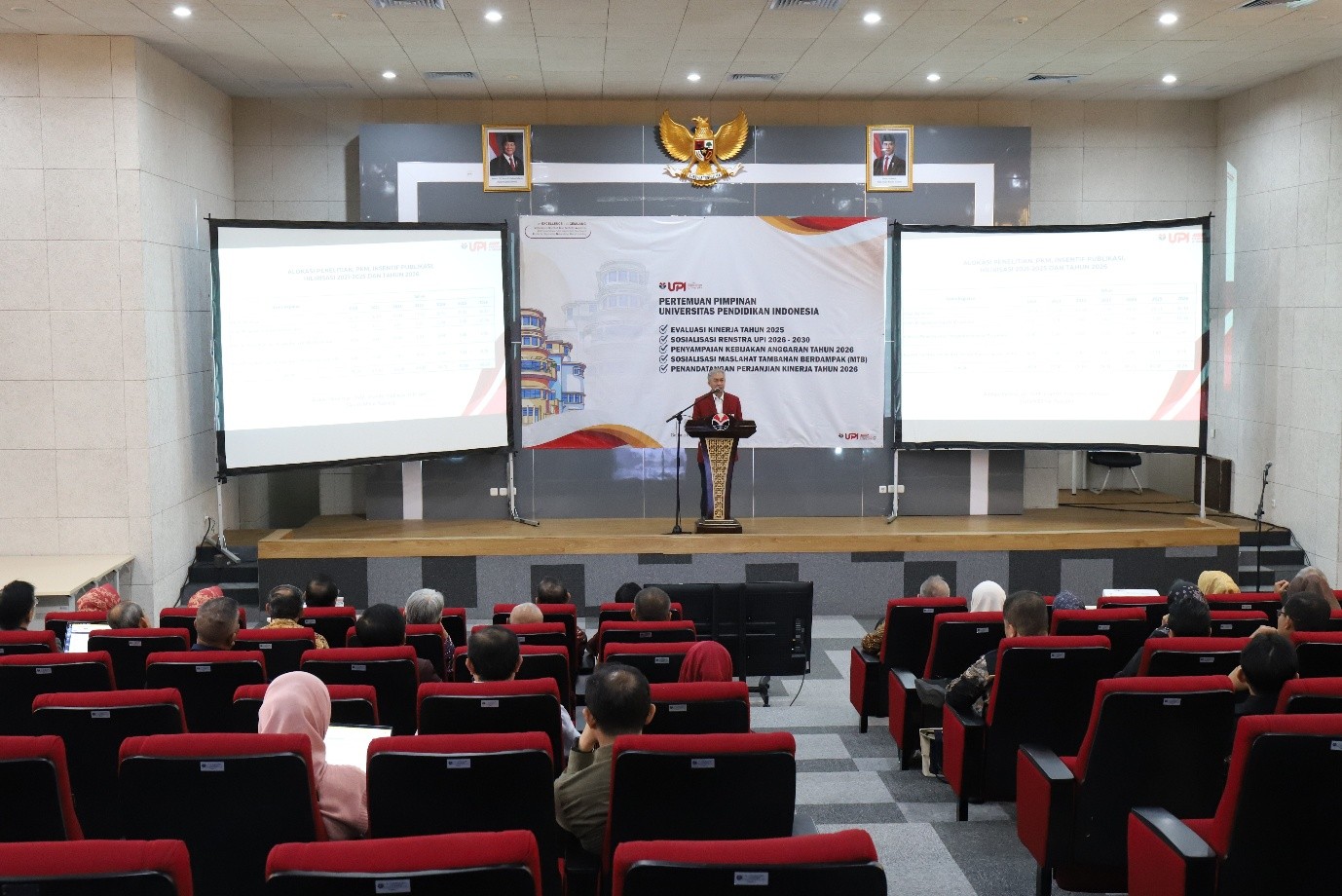
Universitas Pendidikan Indonesia (UPI) held a Leadership Meeting at the New Graduate School Building Auditorium on January 29, bringing together university leaders to consolidate strategies and strengthen institutional direction for the coming year. The meeting served as a platform to review the university’s 2025 achievements while preparing the operational roadmap for 2026.
The forum focused on strengthening institutional commitment through several key agendas, including the evaluation of UPI’s 2025 performance, the introduction of the university’s Strategic Plan (Renstra) for 2026 – 2030, the 2026 budget policy briefing, the rollout of the Maslahat Tambahan Berdampak (MTB) incentive scheme, and the signing of 2026 Performance Agreements (Perjanjian Kinerja) between the Rector and leaders of each work unit.
During the 2025 performance review session, Prof. Dr. Rudi Susilana, M.Si., Vice Rector for Planning and Finance, reported that UPI achieved 90.9% of its 2025 performance agreement targets. Out of 11 indicators, 10 were either achieved or exceeded. One indicator still requires improvement: the percentage of lecturers carrying out Tridharma activities outside their own study program, other universities, or industry, as well as mentoring students involved in off program activities. This indicator reached 77.1% of the 80% target.
In terms of governance performance, UPI also recorded a strong achievement in the 2025 Government Institution Performance Assessment (AKIP) with a score of 93.95, earning the AA rating. Fourteen units within the university also received the same AA status. The meeting highlighted the importance of continuing to accelerate unit level performance improvement and maintaining consistent reporting to ensure institutional targets are achieved with greater impact.
Looking ahead, Dr. Yatun Romdonah Awaliah, M.Pd., Director of the Planning and Organization Directorate, explained that the approved UPI Strategic Plan (Renstra) 2026 – 2030 positions the university as an Asia level reference institution in education and several leading fields. This vision is supported by five strategic priorities, including strengthening the quality of education and graduates, enhancing research and innovation, and improving financial independence through optimal asset management.
Meanwhile, Prof. Dr. Tri Indri Hardini, M.Pd., Vice Rector for Human Resources and Information Systems, introduced the MTB policy, which aims to strengthen performance based remuneration within the university. Beginning in 2026, MTB payments will include a base salary component and a unit performance component, while the individual performance component is scheduled to be implemented in 2027 based on performance achievements in 2026.
UPI Rector Prof. Dr. H. Didi Sukyadi, M.A., emphasized the need for a shift in work culture to enable UPI to achieve significant progress in performance and competitiveness. In outlining the university’s strategic direction, the Rector highlighted the importance of strengthening research capacity by increasing research and community-service funding. As part of this effort, UPI aims to move toward a total research budget including unit support of approximately Rp70 billion to support its competitiveness strategy.
The leadership meeting concluded with the signing of the 2026 Performance Agreements, reaffirming the commitment of each work unit to translate university targets into operational programs. The process will be supported by integrated monitoring systems across planning, reporting, and performance platforms, ensuring that the university’s 2026 achievements are not only measurable but also meaningful in their impact. (CS)
This leadership and governance initiative contributes to SDG 4: Quality Education by strengthening institutional management that supports educational quality and graduate development. It also advances SDG 16: Peace, Justice and Strong Institutions by promoting transparent, accountable, and performance based governance within one of Indonesia’s leading universities.