



Bandung, UPI
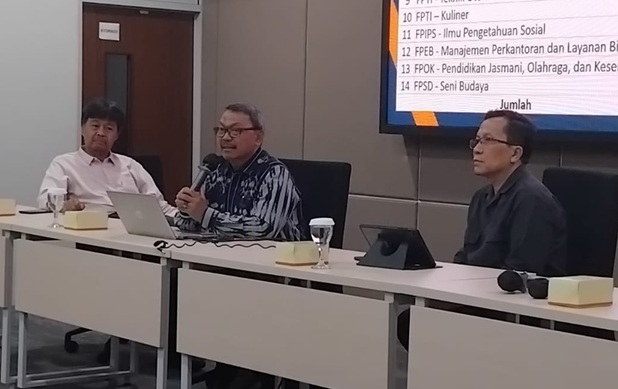
The Teacher Professional Education (PPG) Study Program at the School of Graduate Studies of Universitas Pendidikan Indonesia (UPI) held a socialization and coordination meeting to prepare for the upcoming PPG for Future Teachers (Calon Guru Prajab) Wave 1, 2026. The meeting aimed to ensure academic, institutional, and technical readiness for both classroom learning and Field Practice Experience (Praktik Pengalaman Lapangan / PPL) in accordance with the latest technical guidelines issued by the Directorate General of Teachers, Education Personnel, and Teacher Education under the Ministry of Education, Culture, Research, and Technology of Indonesia.
The coordination meeting took place on Thursday, January 22, 2026, at the 6th floor Auditorium of the PPG Building, UPI. It was chaired by the PPG Program Chair, Prof. Dr. H. Asep Herry Hernawan, M.Pd., and attended by program-study leaders, subject-area coordinators, permanent lecturers, and facilitators involved in UPI’s PPG programs.
During the meeting, participants discussed several important aspects of the upcoming program. These included the latest policy updates for the 2026 PPG Future Teacher program, the draft course schedule, readiness of teaching personnel, and the use of the Learning Management System (LMS) along with other instructional technologies. The discussion also covered the number of learning groups (rombel), the distribution of core, selective, and elective courses, as well as the overall academic calendar for the 2026 Wave-1 PPG Future Teacher program.
Particular attention was given to the implementation of Praktik Pengalaman Lapangan (PPL). Dr. Asep Suryana, M.Pd., Head of the Professional Education Division (Probidik), explained the strategy for guided field practice, including the roles of field supervisors (dosen pembimbing) and mentor teachers (guru pamong). He also outlined the monitoring and mentoring mechanisms that will support students during their placements at partner schools. PPL is considered a key stage in developing the professional competence of future teachers through direct classroom and school-based teaching experience.
To further strengthen shared understanding among PPG subject-area managers, an official socialization session for the 2026 Future Teacher PPG Wave 1 was held on Tuesday, January 27, 2026, at the GH Universal Hotel Bandung. The event was opened by the Dean of the School of Graduate Studies at UPI, Prof. Dr. Juntika Nurihsan, M.Pd. In his remarks, he highlighted the importance of moral and ethical character development among participants in the Calon Guru PPG program, emphasizing that this track differs from earlier PPG programs designed for teachers who are already in service.
The socialization session provided participants with detailed information about the 2026 PPG policy for future teachers, the curriculum structure, classroom-learning flow, and the integration of educational philosophy and value-based teaching. Other key topics included case-based learning, deep-learning strategies, assessment systems, and Universal Design for Learning (UDL).
Participants were also introduced to the program’s academic orientation, remedial components (matrikulasi), and the integration of curricular and non-curricular activities aimed at strengthening both the character and professional competencies of future teachers.
Through these coordination and socialization activities, the PPG Program at the School of Graduate Studies, UPIreaffirmed its commitment to implementing the Future Teacher PPG program in a professional, accountable, and quality-oriented manner. The preparation is expected to support the smooth implementation of learning activities in 2026 and contribute to producing professional teachers who are ready to support the improvement of national education quality.
In addition, this preparation initiative contributes to SDG 4: Quality Education by strengthening teacher education and pedagogical competence. It also supports SDG 8: Decent Work and Economic Growth by preparing work-ready teachers, and SDG 17: Partnerships for the Goals through collaboration among universities, schools, and the national education ministry. (Genda)