



Bandung, UPI
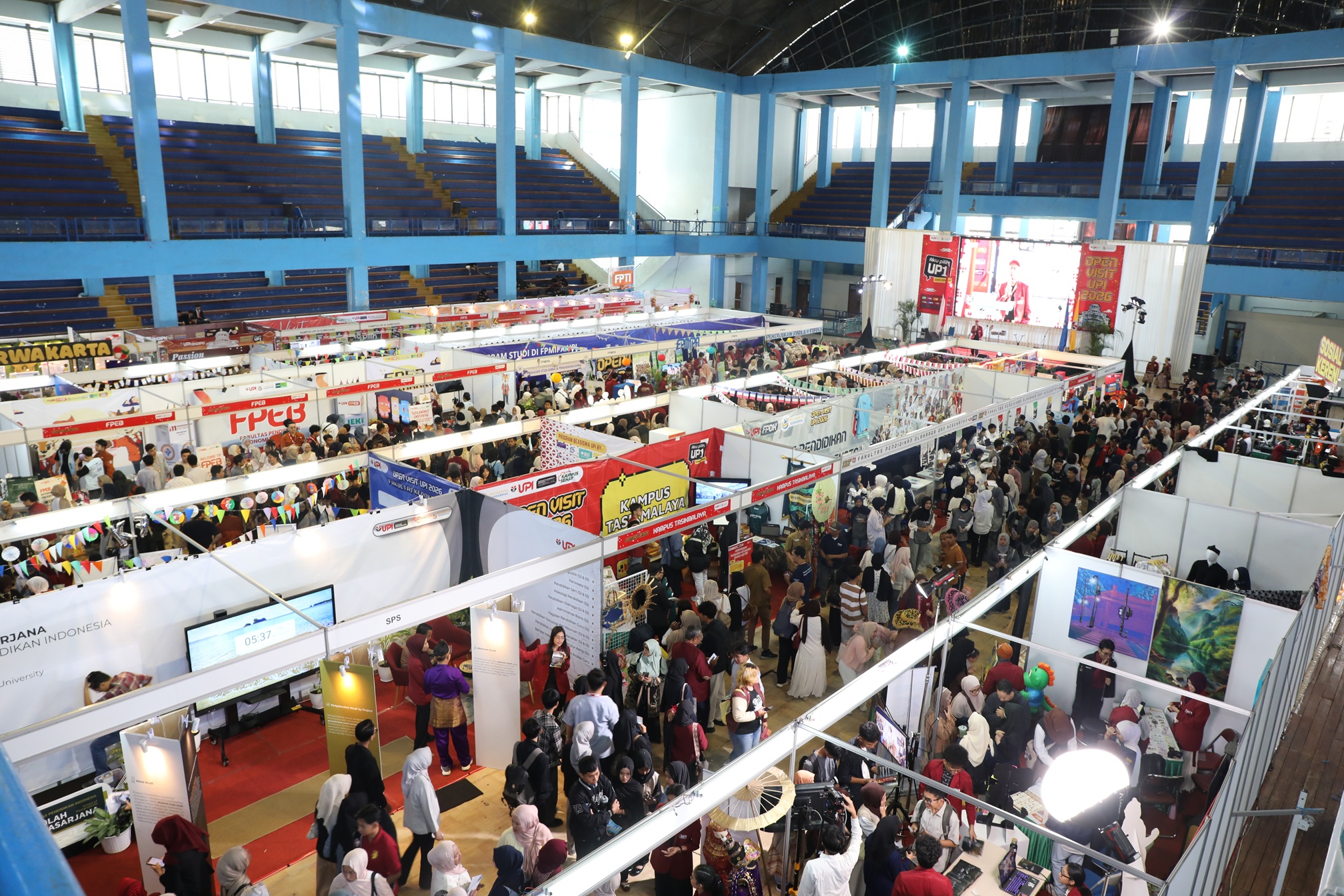
Universitas Pendidikan Indonesia (UPI) once again held Open Visit UPI 2026 as part of its effort to introduce the university comprehensively to prospective students, particularly those from senior high schools and equivalent institutions (SMA/SMK/MA). The event marked the second edition following the success of last year’s program, which received strong public interest. The activity took place at the UPI Gymnasium Building, Jl. Dr. Setiabudhi No. 229, Bandung, on Saturday, January 31, 2026.
UPI Rector Prof. Didi Sukyadi M.A explained that the program was organized again due to its significant impact in helping prospective students better understand UPI’s academic environment, study programs, and education system. Through this event, UPI aims to attract high quality students from its key stakeholders, particularly the community and learners at the secondary education level.
During the event, participants received direct information about UPI at the main activity hall and were also given the opportunity to explore various faculties and study programs according to their interests. The program was designed to provide a holistic introduction to UPI, including its faculties, study programs, and supporting units such as the Directorate of Student Affairs, the Directorate of Education, and other academic support bodies that assist students throughout their academic journey.
Public enthusiasm for the event was remarkably high. By the day of the event, more than 6,000 participants had registered. The Open Visit was conducted in several sessions, each attended by around 1,500 participants. The Rector expressed his appreciation for the strong public interest and hoped the event would help prospective students make informed decisions about their future education.
“Regarding student capacity, UPI currently maintains an intake of around 12,000 students per year across undergraduate (S1), master’s (S2), and doctoral (S3) programs. Although UPI has added new buildings and recruited additional lecturers, this policy still takes into account recommendations from both academic and medical perspectives,” he said.
“In terms of capacity, UPI could actually accommodate between 13,000 and 14,000 students per year, supported by new building developments at the Faculty of Economic and Business Education, the Faculty of Technology and Industrial Education, the Faculty of Art and Design Education, as well as facility expansions at campuses in Tasikmalaya, Cibiru, and Sumedang,” he added.
Regarding institutional development, UPI has not opened any new faculties yet, as the university is preparing for its upcoming institutional accreditation, which will expire next year. In the future, the university plans to strengthen the establishment of new study programs, particularly at the master’s and doctoral levels, focusing on multidisciplinary and STEM-based fields that support national priorities in food, energy, and water. Some of UPI’s flagship areas include renewable energy and robotics.
On the same occasion, Prof. Didi Sukyadi also addressed “Meanwhile, regarding the policy on the use of the Academic Ability Test (TKA) in university admissions, UPI emphasized that it will follow the joint decision established through the Forum of Rectors of Indonesian State Universities. The Rector of UPI views the TKA as having positive value as a benchmark and point of comparison that can enhance the validity of assessments in the new student selection process.”
Through Open Visit UPI 2026, UPI reaffirms its commitment to providing transparent and informative services for prospective students while ensuring that admitted students are well-prepared individuals ready to grow and contribute to society and national development.
Moreover, this initiative supports SDG 4 (Quality Education) by expanding equitable and transparent access to higher-education information, particularly for secondary-school students, and by strengthening an inclusive admission ecosystem that encourages lifelong learning and national development. (Rija/DN)