



Bandung, UPI
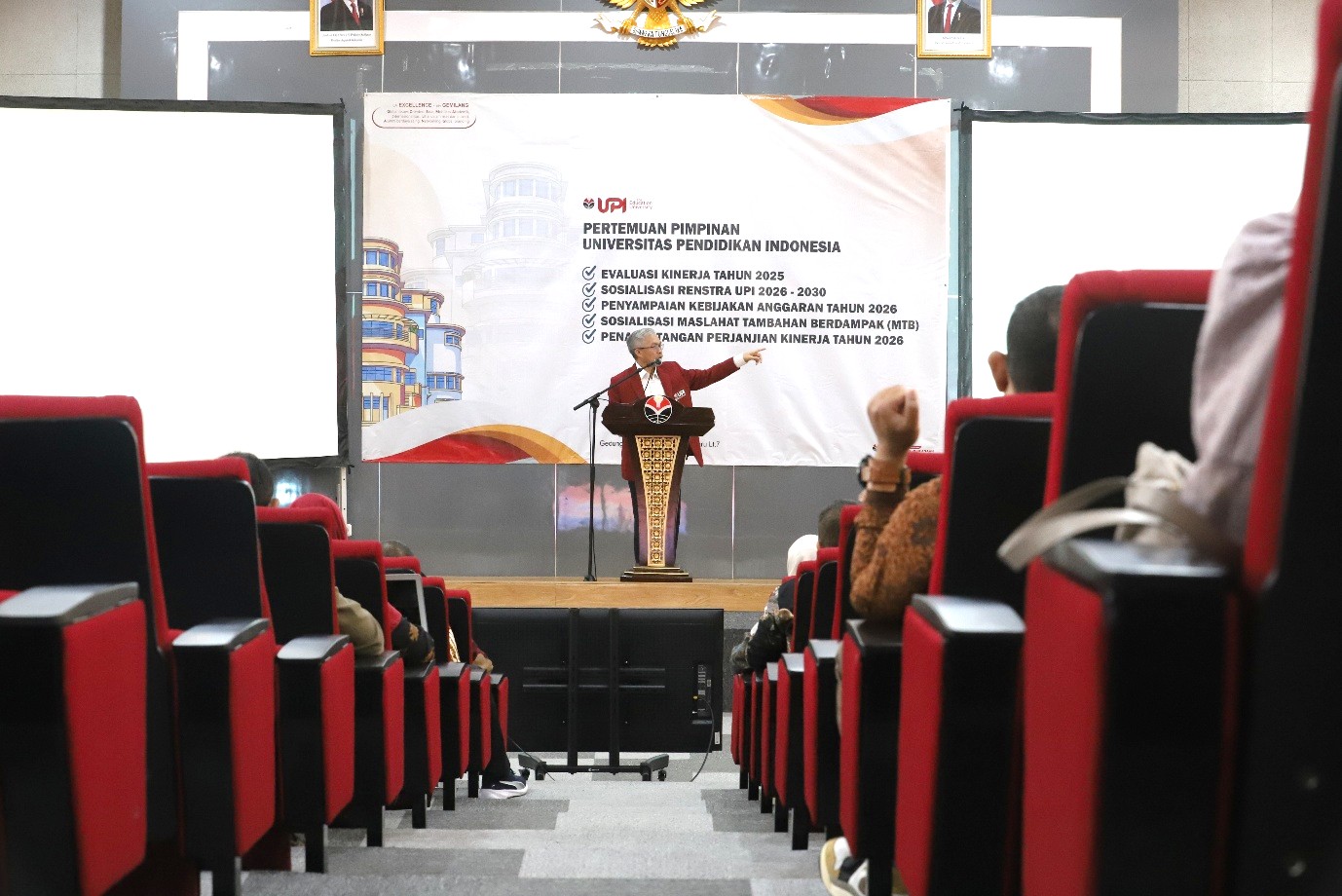
Universitas Pendidikan Indonesia (UPI) has strengthened its performance measurement system for 2026 by setting 39 Main Performance Indicators (IKU) and 80 Activity Level Performance Indicators (IKK) as benchmarks for all work units across the university. This framework was reaffirmed during the UPI Leadership Meeting held at the SPs New Building Auditorium on January 29.
The meeting discussed several strategic agendas, including the evaluation of UPI’s 2025 performance, the introduction of the UPI Strategic Plan (Renstra) for 2026–2030, the 2026 budget-policy briefing, and the launch of the Maslahat Tambahan Berdampak (MTB) scheme. A central focus of the meeting was ensuring that the university’s goals can be clearly measured and monitored from the institutional level down to individual units.
During the session, Dr. Yatun Romdonah Awaliah, M.Pd., Director of the Planning and Organization Directorate, explained that the indicators used by each unit are derived directly from the Performance Agreement (Perjanjian Kinerja) signed between the UPI Rector and the Ministry of Education. This alignment ensures that institutional goals remain consistent and connected across all levels of the university.
The performance-indicator framework consists of 39 IKUs and 80 IKKs, which will serve as the main references for evaluating UPI’s achievements in 2026.
At the institutional level, IKU UPI indicators are designed to synchronize the targets outlined in the university’s strategic plan with those agreed upon with the ministry. Meanwhile, IKK UPI indicators are further developed from the IKUs or adjusted according to the specific duties and functions of each unit. This system helps clarify responsibilities so that every unit understands how its work contributes to achieving the university’s broader goals.
Following the signing of the performance agreements, unit leaders were instructed to immediately prepare quarterly action plans and performance targets. These plans will support regular monitoring and evaluation throughout the year.
UPI is also strengthening its monitoring system by integrating e-planning, e-reporting, and e-performance platforms, allowing programs and achievements to be tracked and evaluated more systematically.
UPI Rector, Prof. Dr. H. Didi Sukyadi, M.A., emphasized that strengthening performance governance also requires a clear cascading system. Unit level Performance Agreements must be broken down further into sub-unit agreements. UPI has set February 26 as the deadline for this cascading process from the university level to units, and from units to their respective sub-units.
These sub unit agreements will later serve as the foundation for drafting individual performance targets (SKP) for lecturers and administrative staff. They will also become the basis for quarterly monitoring and evaluation throughout the year.
The Rector also highlighted that the 2026 performance assessment will place greater emphasis on actual outcomes rather than merely focusing on budget absorption. Achieving IKU and IKK targets will become the main measure of success.
In addition, unit performance results will be directly linked to the MTB scheme, particularly within the “unit performance” component. This approach reinforces the idea that strong performance management is a shared responsibility among all leaders and units within the university.
UPI emphasized that institutional targets should not remain as formal documents alone. Instead, they must be translated into measurable action plans, regularly monitored, and integrated into performance-evaluation systems as well as performance-based welfare schemes.
Through this approach, every work unit is expected to move in the same direction toward achieving UPI’s 2026 targets while strengthening the university’s overall competitiveness. (CS)
This institutional-performance framework contributes to SDG 4: Quality Education by promoting accountability and evidence-based management in higher education, and supports SDG 16: Peace, Justice and Strong Institutions by strengthening transparent, systematic, and results-oriented governance at the university level.