
English
Indonesia

Virtual Student Study Service (KKN Virtual) in UPI

28 Oct 2021 • Humas UPI

The COVID-19 pandemic has undoubtedly shifted our activities by a huge margin, from having to attend school and work physically, workers, faculty members and students alike now have to opt for virtual meetings and remote activities to minimize physical interaction as much as possible in order to slow down the spreading of the virus.

On-site activities are limited, unless absolutely necessary and must follow the health protocol set by the government. Of course, this applies to almost every activity in every field, including education, and Student Study Service or better known as Kuliah Kerja Nyata (KKN) in Indonesian, is no exception to it. Due to the protocols, 7th semester students must accomplish their Student Study Service virtually as required by law.

It is no new knowledge by this point that virtual class has its own series of challenges and problems, whether it be technicality related problems that commonly occur such as connection instability, hardware or software problems, and even psychological related problems. Virtual class induced a significant amount of stress toward students in various grades, from schools to varsity. Despite those problems, students still have to go on with their studies and projects.

Jonathan discussing about the Student Study Service with SMPN 28’s headmaster

Today, we are diving into Virtual Student Study Service through the eyes of none other than a 7th semester student themselves, Jonathan Suara Patty. He is a student majoring in Computer Science, Faculty of Mathematics and Science who is currently conducting his Student Study Program virtually, in collaboration with SMPN 28 Bandung.

He explained that despite what it might seem on the surface to people, Virtual Student Study Service is not so much different than a conventional one. The glaring difference is that the events and programs must be conducted through online platforms, such as ZOOM Meetings, Google Meet, and other similar platforms. The Virtual Student Study Service held by UPI starts from August 26th and lasts until September 26th, 2021; however, he explained that the duration of the service is not counted using the days and dates, but rather hours spent on the activities and programs made, and each student must spend at least 120 hours contributing to the activities and programs.

Upon asked what kind of projects he and his team are doing, he explained that projects usually vary and is adapted towards the goal, or the vision taught by the campus and faculty members. As for himself, his team was given the theme ‘literacy’ as the vision of their project, with the goal of improving the intensity of literacy in general public. The project later gets divided into six assignments, in which three of them are mandatory, and the other three being optional. All students must participate in mandatory assignment. The three mandatory assignments are numeracy literacy, science, reading and writing which can only be conducted in and achieved through teaching schools.

Jonathan in a virtual meeting with the students and the teachers of SMPN 28

“The main obstacle we faced was allocating assignments for school students in order to fill the minimum hour required for Student Study Service, due to the fact that there were not many hours allocated to literacy class in school these days,” he mentioned. The class is usually held once or twice on a weekly basis. To solve this type of problem, he mentioned that the college students who are conducting Student Service Study try to allocate assignments through the student’s homework or student’s class activities in their respective schools in order to meet the 120-hour requirement.

Despite the obstacles and hardships, Jonathan believes that there are plenty of advantageous benefits that can be received through virtual Student Study Service, for one is that college students learn how to be flexible, adapt and communicate. In order to conduct Student Study Service, there had to be communication regarding the activity between the college students and the related school, which also applies when collaborating with the general public. College students learns how to properly negotiate and communicate with school headmasters and community groups regarding their activities and how their programs will benefit schools and general public. College students will learn about themselves, particularly their strengths, making plans, and communicate their strengths towards people.

Jonathan mentioned that there seem to be a lot of tasks given and that students are being encouraged to learn more about their own strengths when asked about what his impression of the Virtual Student Study Service was, he also added that students gained a lot of experience that will undoubtedly come in handy later on in the future such as experiences of communicating with groups or people outside of the university environment.

He advised that students who are about to or are currently conducting Virtual Student Study Service, should learn how to communicate actively, because the ability and the courage to actively communicate with various parties regarding their activities and programs will be beneficial for students when conducting Student Study Service. (Intan Annisya Puspa Jelita, Mahasiswa Bahasa dan Sastra Inggris, FPBS UPI)
UPI Ranked #3 Top University in Indonesia according to Times Higher Education (THE) World University Rankings 2022

03 Sep 2021 • Humas UPI

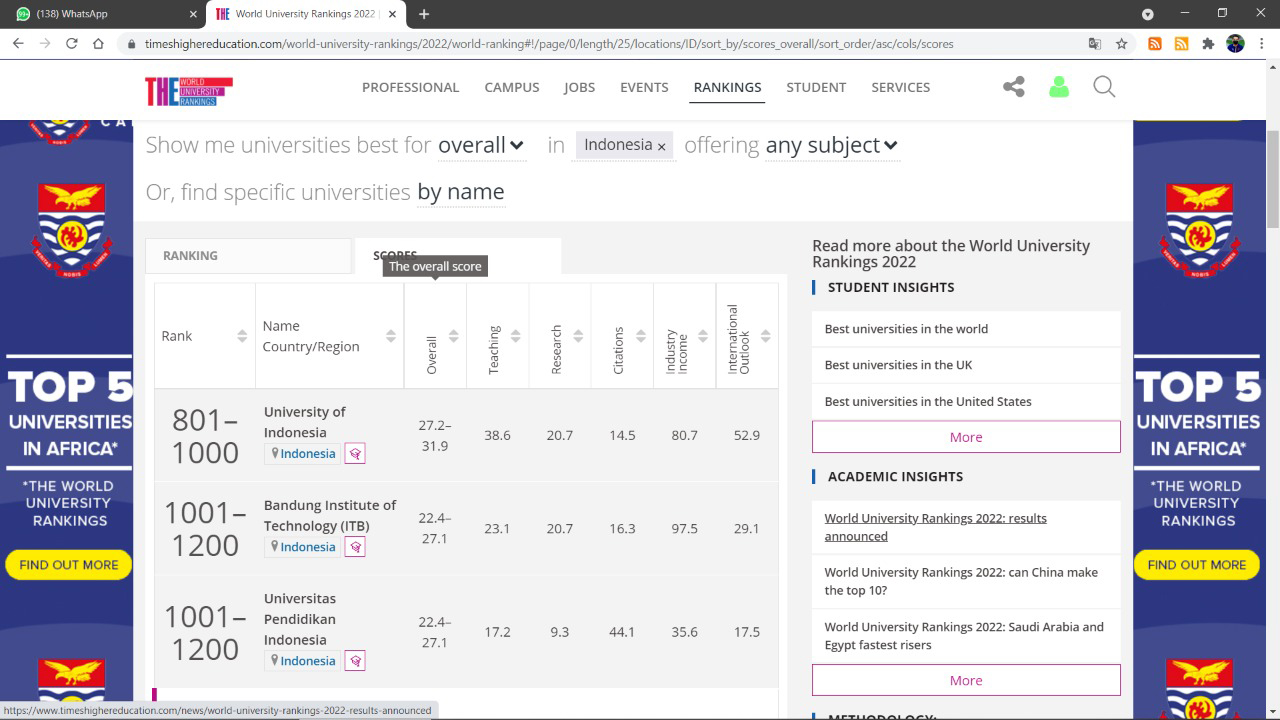
Universitas Pendidikan Indonesia is ranked #3 Top University in Indonesia according to THE World University Rankings 2022. The 1st position went to Universitas Indonesia, while the 2nd position was occupied by Institut Teknologi Bandung. Positions 4 to 10 were occupied by Universitas Airlangga, Universitas BINUS, Universitas Brawijaya, Universitas Dipenogoro, Universitas Gadjah Mada, Universitas Hasanudin, and IPB. THE World University Ranking is a highly prestigious ranking institution that is recognized worldwide.

The ranking carried out by THE World University Rankings 2022 only include the best 1,600 universities in 99 countries from 2,100 universities that meet THE requirements to be able to participate in the rankings by submitting data. The rankings were based on 13 carefully calibrated performance indicators that measure institutional performance in four areas, namely teaching, research and knowledge transfer in the form of citations, earnings from industry, and international outlook.

Based on the publication of THE World University Rankings 2022, the ranking was undertaken by analyzing 108 million more citations from 14.4 million research publications and includes survey results from nearly 22,000 academics worldwide. In all, the data were collected over 430,000 data points.

Based on data released by THE World University Rankings 2022, Universitas Pendidikan Indonesia was ranked in the world at positions 1001-1200. UPI’s overall score in THE World University Rankings 2022 is 22.4-27.1, with details in the teaching field of 17.2, in the field of research and citations of 9.3 and 44.1, in the field of income from industries of 35, 6, as well as in the field of international worldviews of 17.5

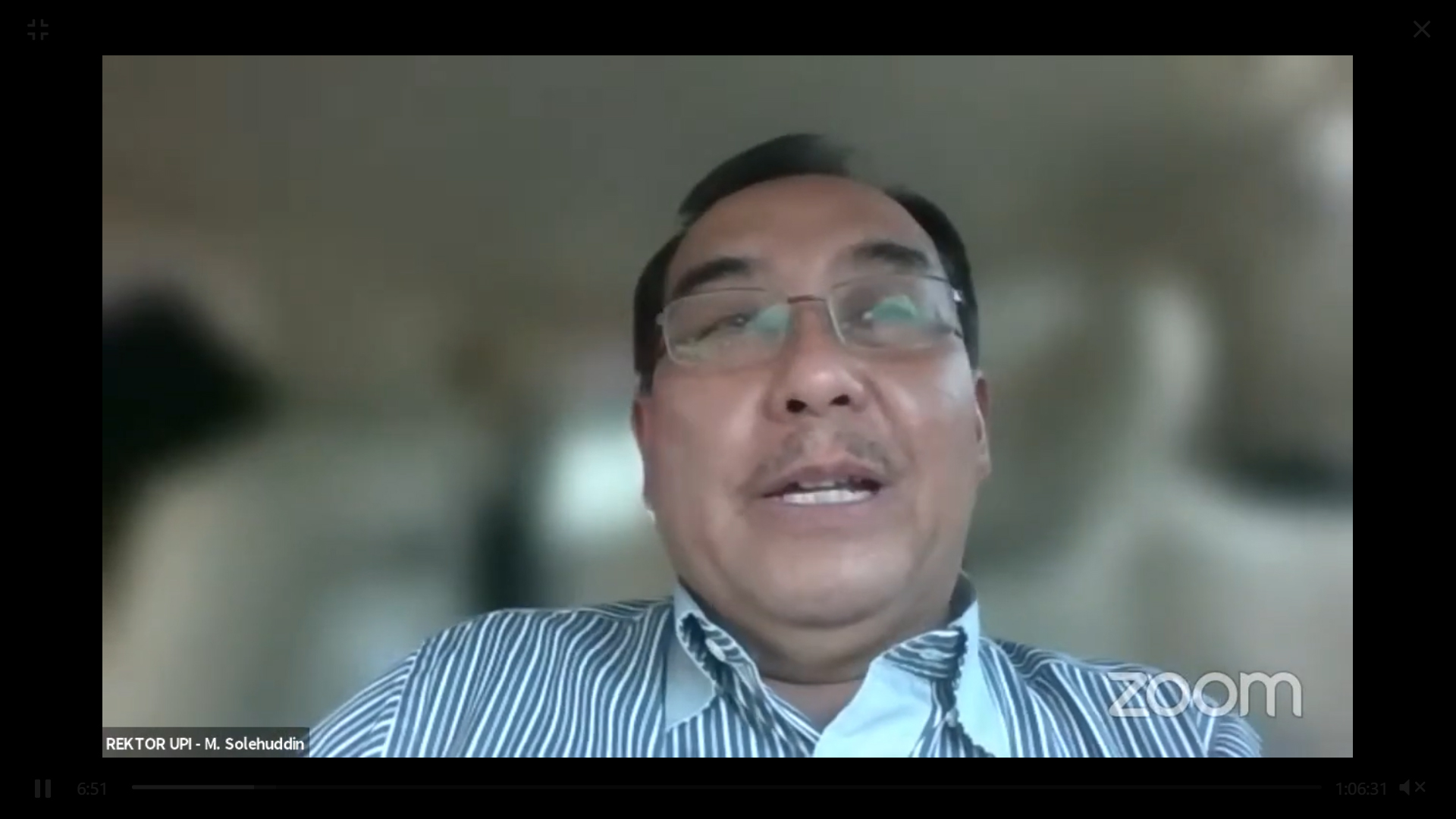
This achievement should be seen as an invitation for UPI to continually improve many aspects of its services so that the ranking can be advanced in the future (Rector of Universitas Pendidikan Indonesia, Prof. Dr. M. Solehuddin, M.Pd., MA)

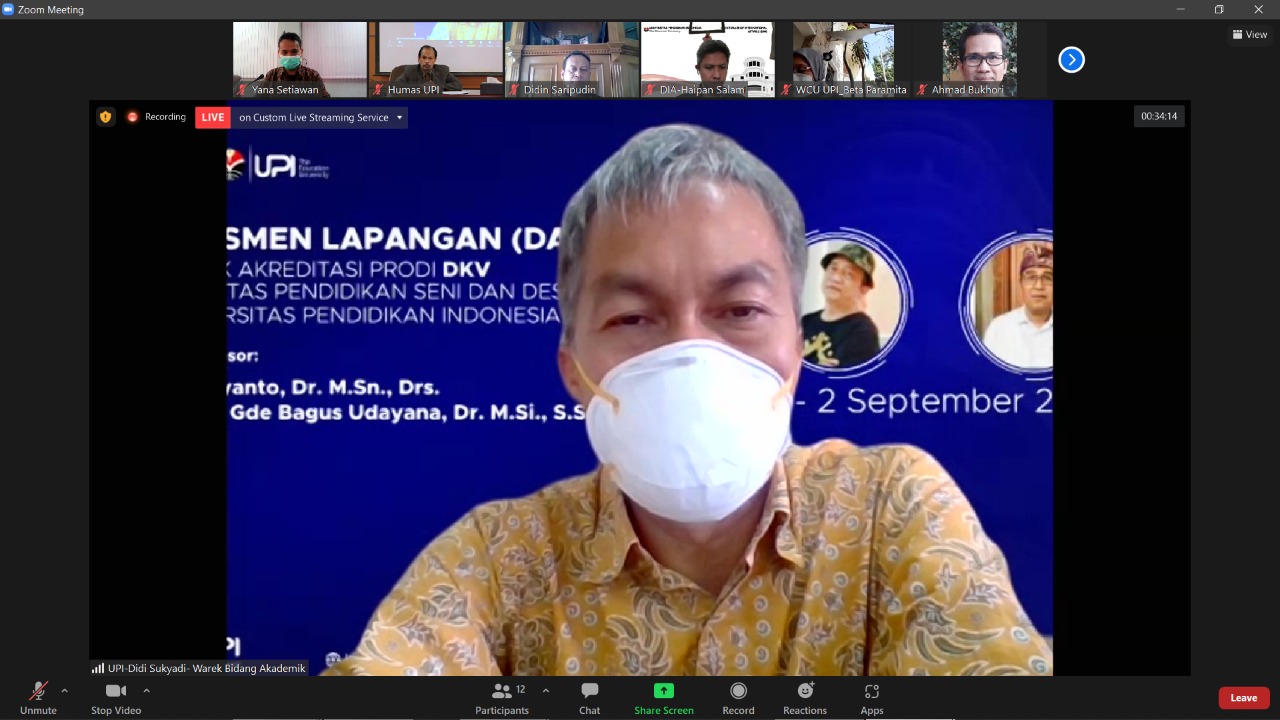
UPI’s Directorate of International Affairs (DIA) Held 2021 WCU DIKTI Socialization

08 Apr 2021 • Humas UPI

Friday (26/03/2021): The Directorate of International Affairs (DIA) held a socialization event to discuss the results of the 2021 DIKTI WCU proposal review. This activity was carried out online with the presence of the Vice Rector for Research in International Cooperation and Business (RIKU), Prof. Dr. H. Adang Suherman, MA., DIA Director Ahmad Buchori Muslim, Ph.D., Head of International Cooperation and University Ranking Haipan Salam, Ph.D, as well as directors, deans, heads of offices, head of UPT and other invited participants. In the initial presentation, the Director of DIA said that his directorate was working on UPI’s university ranking. Some of the ways that have been carried out were conducting international classes, founding Center of Sundanology and holding the annual KJP Award.

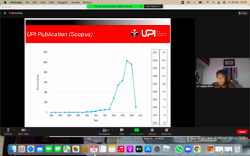
In the next presentation, the Head of the International Cooperation and University Ranking Division Haipan Salam, Ph.D. talked aboutpublished articles on Scopus which were dominated by  conference papers (536 articles) instead of  Scopus-indexed international journals (409 articles). It is hoped that UPI, through its lecturers, will increase the publication of articles in Scopus-indexed international journals compared to conference papers because it would have more impacts on the university ranking. For its publication collaboration, UPI collaborated with countries such as Malaysia, Japan, Australia, Taiwan, England, the United States, China, Germany, Nigeria, South Korea and Turkey. Malaysia is themost collaborated country  with 65 articles written in Scopus international journals.

UPI’s ranking in QS WUR by Subject Education and Training from 2019-2021 was discussed as one of the topics in the presentation. In 2019, UPI ranked the 457th; in 2020, UPI ranked the 291st (globally) in Asia’s first Top 50; and in 2021 (spring), UPI ranked at 251th out of300. In the WCU proposal submitted to DIKTI, there were several recommendations from the institutional directorate and the Inspector General of Higher Education as follows:

  1. The Rector of UPI along with the entire academic community together bear the responsibility of working harder to achieve the WUR 1000 in 2024.
  2. Improving the faculty-student ratio (accelerated program; adding the number of lecturers).
  3. Increasing publications in Scopus-indexed international journals (not international conferences).
  4. Optimizing budget use.

Meanwhile, the specific recommendations given by the Directorate of Institutions and the Inspectorate General for UPI are as follows: (1) Increasing the visibility of UPI in the international arena; (2) Increasing the recognition of UPI lecturers (academic recharging, collaborative research, publications in top tier journals, becoming journal reviewers and editorials, active in journal socialization and editorial, active in world scientific socialization, hosting  international conferences, informative social media and website updates  in english); (3) Research programs for research topics that have high uniqueness, such as seaweed, cocoa, etc .; (4) Collaborative research program for university receiving WCU grant;. (5) International publication program with reviewed journal type; (6) Joining a global class research group and collaborating with world-class researchers; (7) Reward program for lecturers who have increased their number of publications and citations; (8) Alumni Gathering; (9) Conducting meetings / gatherings with companies that use graduates (concentrating more on domestic companies).

The UPI WCU program designed in 2021 is as follows:

No.ProgramsTotalAllocation
1Collaborative International Publications2520 millions
2Call for papers (5 special topics)3100 millions
3Indonesia Collaborative Research (PPKI)4100 millions for host; 50 millions for partnership
4Alumni Executive Gathering510 millions
5Summer Program750 millions
6Visiting Professor (Smart Class Lectures)205 millions/month

This budget was provided for each program designed to improve UPI’s ranking program. It is hoped that this WCU program can increase the ranking of UPI with a target in 2024 to be in the top 1000 in QR WUR. Hopefully what has been attempted and planned can be achieved in accordance with the target set by the UPI WCU Team. (Humas UPI/Translator: Aditya)

UPI Library Services Launching: RepoVOS and CERIA Services to Satisfy the UPI Library Learning Resources Needs

08 Apr 2021 • Humas UPI

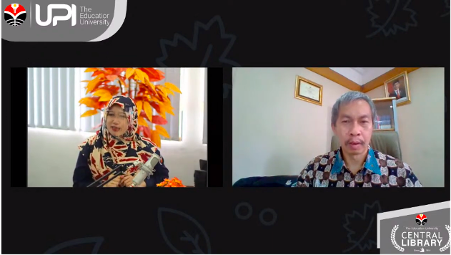
Information needs is something that is significant for everyone in the socio-economic aspect. Regardless of the level of economy, profession, race and gender, without having enough information, a person will not be able to complete the tasks and problems that they have properly; it is undeniable that libraries are the best information providers. During the pandemic, everyone must keep their physical distance from one another and avoid crowds. However, this does not mean that the information needs are no longer a necessity, especially in education. With the long distance education (PJJ) policy, libraries have responsibility to make information accessible anywhere and anytime. To meet these needs, UPI Library launched RepoVOS and CERIA on Thursday (25/03/2021). RepoVOS (Repository UPI View on Screen) and CERIA (Cetak dan Kirim Koleksi Akademik) are two of the newest services of UPI Library. These two services were inaugurated at the BISA BERKAWAN -Casual Talk with Librarians- with the theme “Launching of UPI Library Services: RepoVOS Services (Repository UPI View on Screen) and CERIA (Cetak dan Kirim Koleksi Akademik) toMeet Readers’ Need for Learning Resources”. This event was carried out online and streamed on three UPI Library social media channels, Instagram, Youtube and Facebook.

The event was attended by the Vice Chancellor of Education and Student Affairs, Prof. Dr. H. Didi Sukyadi, MA and the Head of UPI Library, Dr. Riche Cynthia J., M.Sc.,  directly giving directions as well as inaugurating the two newest services from the UPI Library. The resource persons include Hada Hidayat Margana (Head of Division for Acquisition of Library Material UPI), Damayanty, M.I.Kom. (Head of UPI Library Service Division) and M. Ridwan Sutisna, M.Pd. (Head of IT and Digital Learning Division (TIPD) STI UPI).

In the first presentation, M. Ridwan Sutisna explained the significance and instructions to install VPN before accessing the information resources collection that is owned by UPI Library. Ridwan also advised UPI readers to properly keep  the SSO (Single Sign On) username account and password account that is owned by the UPI academic community because there will be developments in confidential information access that can only be accessed with that account. If there is any problem related to the UPI academic account, please directly contact the STI Directorate user service channels.

In the second presentation, Hada Hidayat Margana explained the first service innovation, namely RepoVOS (Repository UPI View on Screen), which is a full text reading access service for UPI’s digital collection. It comes from UPI Readers needs to access the student final assignments collection, even though the library cannot be accessed online, making requests for protected repository files increase very rapidly. The UPI library tries to capture this need and tries to improve excellent service for all academicians in meeting the needs of learning resources. With the service of RepoVOS, it is expected that UPI’s Digital Repository collection can be maximally utilized, and UPI Readers will gain unlimited access and convenience.

Damayanty presents the third presentation that still related to the second service innovation, CERIA. Layanan Cetak dan Kirim Koleksi Akademik (CERIA), is a printing and delivery service for UPI Library collections according to online customer orders. Before the pandemic, the UPI Library had a Print on Demand service which provided printing services for collection that UPI Readers need. However, according to current conditions, it is necessary to provide the same services but online. Targetting both non-UPI and UPI library users, CERIA aims to provide users with the information about UPI Library collections that cannot be accessed directly and provide convenience to users in obtaining collections that cannot be accessed directly.

RepoVOS and CERIA facilitates UPI Readers in fulfilling information needs and access to information resources in the UPI Library. Currently, the two services are ready to serve, although they still require further developments. Of course, after the launch of these two services, UPI Libraries will continue to rise and work together to create other service innovations to meet the needs of all UPI Readers, in accordance with the motto “Answers at its best to any quest”. (Herli Bachtiar / UPI Library, Translator: Rayhana Jasmine)

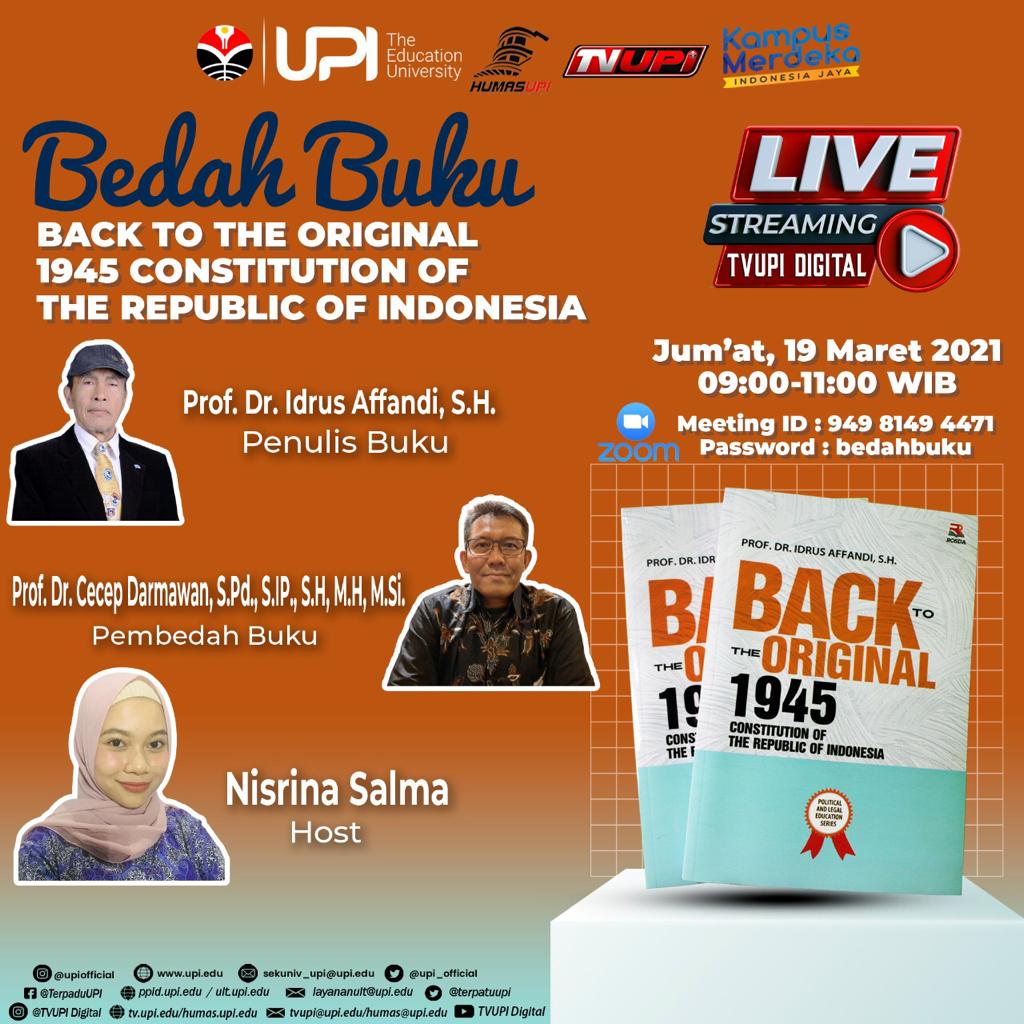
TV UPI HOSTED THE 2ND ONLINE BOOK REVIEW OF “BACK TO THE ORIGINAL CONSTITUTION OF THE REPUBLIC OF INDONESIA”

25 Mar 2021 • Humas UPI

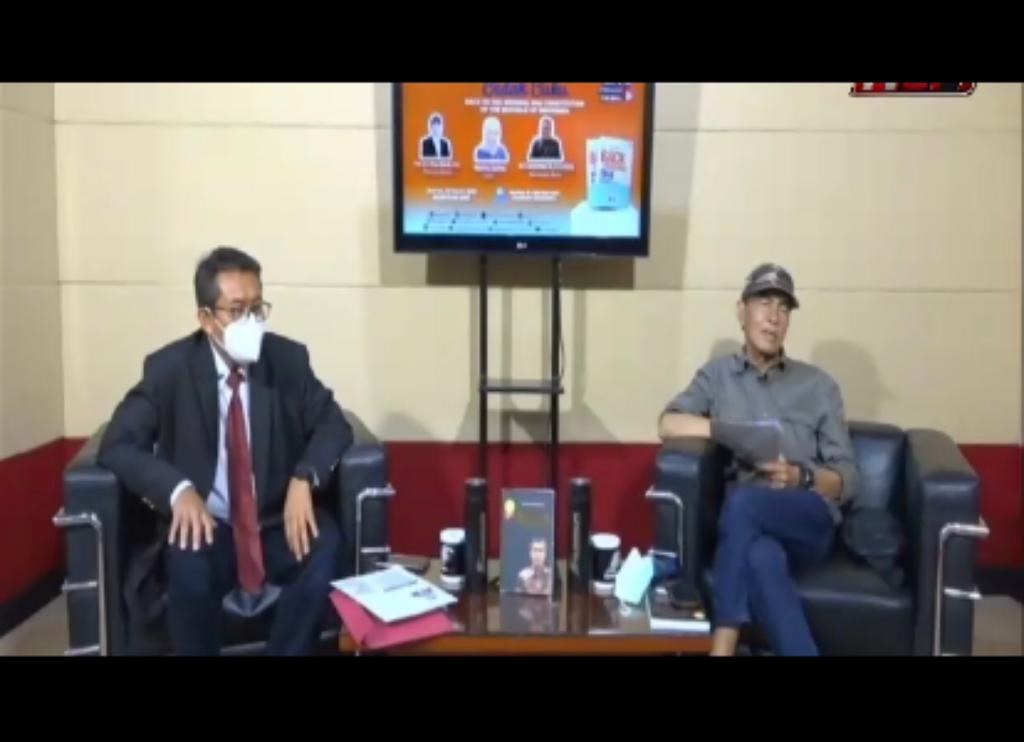
A professor at the Indonesia University of Education wrote a new work yet again. Prof. Dr. Idrus Affandi S.H. is a writer and the presenter at the 2nd book review held by the Indonesia University of Education on Friday (19/03/2021) Prof. Dr. Idrus Affandi S.H. is also a professor of Political Education at the Indonesia University of Education along with being the Secretary of the Trustee at the Indonesian University of Education. The book review, entitled “Back to The Original Constitution of The Republic Of Indonesia”, was held via Zoom and was broadcasted live on TV UPI. The event was hosted by a student of the English Language and Literature study program from the Indonesia University of Education, Nisrina Salma Raniahwati.

“Back to The Original Constitution of The Republic Of Indonesia”or “Kembali ke UUD 1945 Asli “, was written by Prof. Dr. Idrus Affandi S.H. based on current Indonesian politics with increasing numbers of supporters of liberal democracy rather than the Pancasila democracy. The book was written English languange and Indonesia Langunge with the hope that the Indonesian Constitution would be re-amended to the original 1945 constitution, which was in accordance with the Indonesian characteristics.

Written with care and step by step, the book is the result of thorough observations of the nation’s reformations. A long 23 years of continuous reformations has resulted in many major influential events that have had an impact on this nation. Event after event was reviewed by Prof. Dr. Idrus Affandi. He claimed that one of the ways to return the current constitution back to the 1945 constitution was by observing current real events.

The book discusses events of amendments, development of ups and downs, conflicts, divisions, and recriminations during the reformation period. He also claimed that foreign investment is like making a red carpet in a foreign country. For that reason, Prof. Dr. Idrus Affandi S.H. hopes that Indonesia will have a constitution that is in accordance with the characteristics and history of the Indonesian state because the constitution of a country describes the country’s management mechanism for the welfare of the Indonesian people.

Prof. Dr. Cecep Dermawan S.Pd., S.IP., S.H, M.H, M.Si., who is the Head of the Postgraduate Study Program for Citizenship Education at the Indonesian University of Education, reviewed the book by using the retrovirus method with a phenomenological approach.

The book “Kembali ke UUD 1945 Asli“, can be summarized into 6 main points, namely:

  1. Building the Constitution: The study of how we build the current constitution, (Back to the 1945 Constitution, Half-Hearted Amendments, distributing “War Reparation”, “Devide et Empera” New Forms, Missing Generations, Political Literacy, Immediately, Presidential Decree, Pancasila Governor Election, Back to Pancasila Democracy, Three Period).
  2. Towards Greater Indonesia: The movement towards Indonesia Jaya. (Cutting a Generation, Young Leaders, Managing Conflict, Preventing Civil War, Partnering with Saudi Arabia).
  3. Democracy and Ideology: Democracy and Ideology. (One Ideology Cabinet, Chaotic Democracy, “Nyalindung ka Gelung” Party, Impact of Dynastic Politics, Strengthening Diversity, Religious >< Nationalists in the Capital, Two Emil Phenomenon, Political Years, Tracks of the Presidential Election in Pilgub).
  4. Strengthening Character: Strengthen Character. (Building National Character, Starting from Building Human Resources, “Merekedeweng” Tolerance, Political Qibla, Strengthening Nawacita, Reshuffle, Simalakama Fruit)
  5. Religious Nation: A religious nation. (Removing National Revenge, National Penitence, Fitri Revolution, Religion in the State, Re-Remodel the Cabinet, Highest Sacrifice).
  6. National Education: National Education. (Education Policy, Don’t Play With Indonesia, Educational Nationalism, Uniting the Ministry of Education, the Ministry of Research and Technology.

Cecep also reviewed the book of it many advantageous content thtoughly. The event was closed with a QnA session.(Aditya/Humas UPI)

Search