English
Indonesia

KSR PMI UPI Appoints 2026 Chairperson Through MUSANG XXXVII

02 Apr 2026 • Humas UPI

Bandung, UPI

Korps Sukarela Palang Merah Indonesia Unit Universitas Pendidikan Indonesia (KSR PMI Unit UPI)has successfully concluded its 37th Members’ Assembly (Musyawarah Anggota/MUSANG XXXVII), held on Monday (Dec 29, 2025) at Universitas Pendidikan Indonesia. The organization’s highest decision-making forum officially appointed Nabhan Muhammad Ali as Chairperson for the 2026 term and ratified several strategic organizational decisions.

MUSANG XXXVII served as both a performance evaluation forum for the 2025 leadership and a key moment for leadership regeneration. During the assembly, participants approved the Advisory Board Report, the Accountability Report of the Mandate Holder, the organization’s Statutes and Bylaws (AD/ART), and the General Guidelines of the Work Program (GBPK), which will serve as the foundation for the organization’s direction in the coming period.

In addition to appointing the Chairperson, the assembly also confirmed five Advisory Board members for the 2026 term: Priatna Mitra, Rachmat Roswadi P., Zulfiqar A., Nur Cipta M., and Intan Nurul Ilmi. The board is expected to provide strategic guidance and mentorship for the new leadership.

In his inaugural remarks, Chairperson-elect Nabhan Muhammad Ali expressed gratitude for the trust placed in him. “I hope that moving forward we can collectively realize the organization’s goals and aspirations with full responsibility,” he said.

Meanwhile, Advisory Board representative Intan Nurul Ilmi emphasized the importance of consistency in carrying out the mandate until the end of the leadership period. “Every challenge should be met with determination and accountability, so it can be reported responsibly at the next members’ assembly,” she noted.

Additionally, the MUSANG XXXVII process was conducted in a participatory and democratic manner, involving administrators, extraordinary members, and the advisory board. The event reflects KSR PMI Unit UPI’s commitment to building accountable organizational governance aligned with the Sustainable Development Goals (SDGs)—particularly SDG 16: Peace, Justice, and Strong Institutions, through transparent governance and leadership regeneration, and SDG 4: Quality Education, through student character development and organizational learning.

With the conclusion of MUSANG XXXVII, KSR PMI Unit UPI reaffirmed its commitment to continuing its role as an active student organization in humanitarian work and the character development of Universitas Pendidikan Indonesia students. (Ajeng)

KSR PMI UPI Holds the 37th MUSANG: A Forum for Accountability and Leadership Regeneration

02 Apr 2026 • Humas UPI

Bandung, UPI

Korps Sukarela Palang Merah Indonesia Unit Universitas Pendidikan Indonesia (KSR PMI Unit UPI) officially opened its 37th Members’ Assembly (Musyawarah Anggota/MUSANG) on Friday (December 19, 2025) at the FPMIPA C Building, Universitas Pendidikan Indonesia. The event served as the organization’s formal forum to present the 2025 management accountability report while also electing the next Mandate Holder (leader) for the upcoming term.

The 37th MUSANG was attended by active members of KSR PMI Unit UPI and invited guests from various institutions, including representatives from the Bandung City Indonesian Red Cross (PMI), represented by Head of Disaster and Volunteer Division Ace Kusnadi, the Head of PMI Sukasari District A. Agung Pranata, and representatives of student organizations within UPI.

The Chair of the MUSANG Senate emphasized that the members’ assembly is the organization’s highest forum. It functions to evaluate the performance of the current leadership while determining the organization’s future policy direction so that it remains aligned with humanitarian and Red Cross values.

This year’s MUSANG carried the theme “Regenerating Leaders with Integrity: Building a RELEVANT KSR PMI Unit UPI Management (Responsive, Effective, Loyal, Evaluative, Visionary, Active, and Normative). The theme underscores the organization’s commitment to nurturing young volunteers who are both ethical and adaptable to humanitarian challenges.

In his remarks, Ace Kusnadi highlighted the importance of leadership regeneration within volunteer organizations. “Members’ assemblies are strategic moments to produce volunteers who are full of integrity, united, and ready to face future humanitarian challenges,” he said.

Meanwhile, Griselda, Head of Organizational Division I of KSR PMI Unit UPI, expressed appreciation for the support from various stakeholders throughout the past leadership period. She hopes that the outcomes of MUSANG XXXVII will strengthen the organization’s performance in the future.

Chair of the Organizing Committee, Farid Multahadi, added that the event is expected to become an important milestone in strengthening organizational governance and ensuring the continuity of KSR PMI Unit UPI’s humanitarian programs.

Furthermore, through MUSANG XXXVII, KSR PMI Unit UPI reaffirmed its commitment to building a democratic, accountable student organization that upholds humanitarian values. The initiative also contributes to the achievement of the Sustainable Development Goals (SDGs), particularly Goal 16: Peace, Justice, and Strong Institutions, by promoting transparent governance, leadership regeneration, and civic engagement among youth volunteers. (Ajeng)

Turning Poverty into Hope: Tintin Sri Suprihatin at Sekolah Rakyat (People’s School)

31 Mar 2026 • Humas UPI

Bandung, UPI

When Tintin Sri Suprihatin steps into the dormitory of the People’s School (Sekolah Rakyat Menengah Atas 11, Bandung), she sees not just students from Indonesia’s poorest families, but futures waiting to be reshaped. As Principal, assigned by the Bandung City Government and the Ministry of Social Affairs, Tintin views her role as more than leadership—it’s a profound commitment to social justice through education. Her journey from UPI’s English Education program (Undergraduate from 1999 to 2004, and Master’s from 2021 to 2024) to leading this residential school for decile 1 and 2 students (those from extreme poverty) embodies the humanising pedagogy she first embraced at her alma mater.

The unique challenge at Sekolah Rakyat is both its hallmark and its heart: students share strikingly similar backgrounds, starting from near-identical limitations in experience, access, and self-belief. Tintin’s greatest task is not merely to teach content but to rebuild their worldview and ignite hope for tomorrow. Yet from this uniformity emerges unexpected strength, no social gaps divide them, fostering deep solidarity, empathy, and collective confidence. Fully supported by the state with adequate facilities, the focus shifts entirely to meaningful learning experiences.

The school’s boarding system amplifies this impact, immersing students 24/7 in an environment where education permeates daily life. One indelible memory is the first day in the dorms: many children, separated from parents for the first time, clung to friends or marveled at their own proper beds with pure gratitude. Over time, they learned independence. Starting from sharing beds to claiming their space as a mark of a profound growth. Discipline is cultivated through awareness, not force; as students internalize rules and remind each other, true change takes root. For Tintin, success transcends academics, it’s the transformation of attitudes, character building, and newfound hope in every child.

UPI profoundly shaped this vision. As an English Education alumna, Tintin received not just academic knowledge, but a transformative outlook on educators’ roles. Campus life taught collaboration, communication, leadership, and social dynamics through organisations; pedagogy emphasised humanity, viewing each learner as unique. These values directly inform her work: prioritising character over scores, embodying education as life’s changer—inclusive, humane, reaching the neediest. UPI was her place of growth, forming her into an educator who serves, not just teaches.

Campus memories remain vivid. Known as Tina or “Ndhiel”, she cherished English classes that opened minds to language as a bridge to the world. The Pentagon building buzzed with discussions and inspiration; involvement in student associations built responsibility, Taekwondo honed discipline, and Eclipse Adventure Team (EAT) of Hima Bahasa Inggris (English Students’ Association) created bonds through “more eat than adventure.” Even finding her life partner amid it all added personal depth.

To today’s students, Tintin urges: savour every process. Campus is for self-discovery, trying new things, building life’s direction, join students’ organisations for invaluable lessons beyond books. Balance learning with character, relationships, integrity; maximise time to emerge not just job-ready, but impactful. For UPI, she hopes it shines brighter, producing impactful graduates—academically sharp, character-strong, integrity-driven, contributing tangibly to society. Maximise facilities for holistic growth in intellect, skills, and personality Tintin Sri Suprihatin’s path from UPI’s halls to empowering the underserved, mirrors her university’s ethos: education as equity’s engine, turning shared hardship into shared triumph, one transformed life at a time. (VS)

UPI Boosts Solar Power Access for Underprivileged Villagers via LIMAR Program

26 Mar 2026 • Humas UPI

BANDUNG BARAT, UPI

Universitas Pendidikan Indonesia (UPI) is ramping up its community service drive through the UPI Berdampak LIMAR (Listrik Mandiri Rakyat) program, installing two new solar panel units for low-income families in Mekarsari Village, Rongga District, West Bandung Regency. This expansion came during a hands-on monitoring and evaluation of panels already in use for the past six months, bringing sustainable light to homes long in the dark.

UPI Rector Prof. Dr. H. Didi Sukyadi, M.A., alongside Vice Rector for Education and Quality Assurance Prof. Dr. Vanessa Gaffar, S.E., Ak., MBA., inspected the existing setups and chatted directly with beneficiaries about the real-life transformations. The LIMAR initiative targets families without reliable electricity, delivering eco-friendly solar solutions for household lighting to spark nighttime productivity and brighter futures.

Prof. Didi emphasized maintenance for long-term reliability: “With this lighting, villagers can stay active at night and boost their productivity.” The visit also witnessed the on-site installation of the new panels and a review of living conditions, revealing homes needing urgent upgrades—prompting UPI to coordinate renovation funding with partners. Going further, UPI pledged a mosque loudspeaker to amplify the call to prayer across the area. Beneficiary Fatima shared her joy after 15 years without power: “Alhamdulillah, now we have lights—our kids can study at night.”

The event wrapped with Lebaran gift packages for recipients, underscoring UPI’s pledge to impactful community programs tackling basic infrastructure gaps through innovative tech. This initiative directly advances SDG 7 (Affordable and Clean Energy) by providing solar power access to off-grid poor households, promoting renewable rural energy. It supports SDG 4 (Quality Education) as better lighting enables children’s evening studies, and SDG 1 (No Poverty) through improved living standards, home upgrades, and productivity gains. Additionally, it embodies SDG 17 (Partnerships for the Goals) via university-community-stakeholder collaboration for sustainable rural development

One Small Light That Changed Everything: How a Solar Panel Rewrote Life for a Family in the Forests of Rongga

26 Mar 2026 • Humas UPI

BANDUNG BARAT, UPI

Evening falls fast in Fatima’s corner of the world. When the sun slips behind the pine forest that wraps around Mekarsari Village in Rongga Sub-district, West Bandung Regency, the darkness that follows used to be total. For more than fifteen years, this family of four knew only the faint, flickering glow of a damar oil lamp or a candle to see by. Now, for the first time, a steady light burns in their home every night.

That light comes from a small solar panel — installed free of charge by Universitas Pendidikan Indonesia as part of a community empowerment programme — and for Fatima, her husband, and their two children, it has changed almost everything.

“Alhamdulillah, now we have light. The children can study at night,” she says, a quiet smile on her face.

A University Reaches Into the Forest

On Saturday, 14 March 2026, a delegation from Universitas Pendidikan Indonesia made the journey to Mekarsari Village, led by UPI Rector Prof. Dr. H. Didi Sukyadi, M.A., who came in person to see the impact of the university’s solar energy initiative on the ground.

The visit was part of UPI Berdampak LIMAR — short for Listrik Mandiri Rakyat (People’s Independent Electricity) — a public service programme designed to extend energy access to households that have been left behind by the national electricity grid. The programme installs solar panels on the homes of low-income families who lack any reliable source of lighting.

Beyond checking on panels already in use for several months, the team installed new units at the homes of two additional families that day. The programme positions solar technology as a practical and scalable solution for remote communities in Indonesia, where geography and poverty continue to leave millions without access to basic energy infrastructure.

A 4×4 Metre World Without Electricity

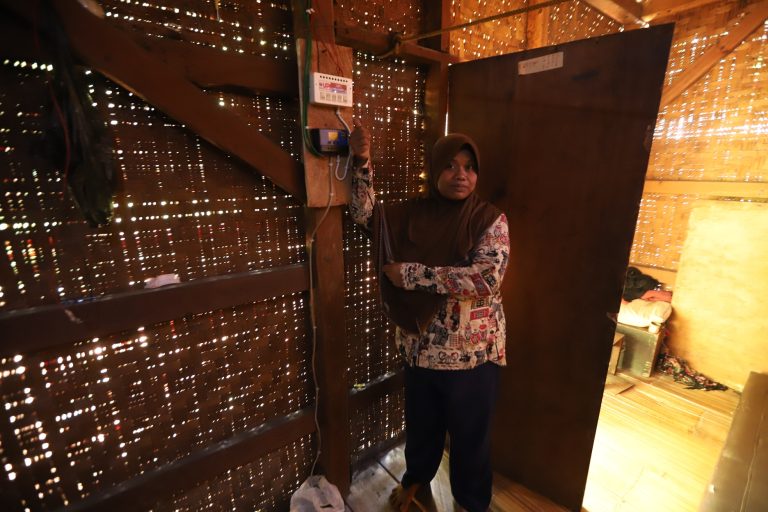
Reaching Fatima’s home requires a walk along a steep forest path. The house itself ,  a modest raised structure measuring roughly four by four metres, sits in the hush of pine trees, its walls woven bamboo, its floors worn wooden planks. In the kitchen, the floor is bare earth, and a wood-fired stove is used for every meal.

In the small yard beside the house, four goats borrowed from neighbours graze in a simple enclosure. Tending them is one of the few ways the family supplements their income. Fatima’s husband works as a pine resin tapper in the surrounding forest, seasonal, unreliable work whose earnings drop sharply when the rains come.

Their two children — a 13-year-old daughter in her second year of junior secondary school, and a six-year-old son just starting primary school — grew up doing their homework only by daylight.

“At night we used the damar lamp or candles. The children could only really study during the day,” Fatima says. The dim flame was never bright enough for reading, so the books stayed closed after sunset.

How the Sun Stays On All Night

The solar panel at Fatima’s home works simply. Throughout the day, the panel absorbs sunlight and stores the energy in a battery. After dark, that stored power feeds the lamps inside; steady, quiet, reliable.

It is a modest system by most standards: enough to run a few lights and charge a mobile phone. But in a home that had nothing, it is transformative. The family’s evenings have been rewritten.

“The children can study at night now, and they can read the Qur’an too,” Fatima says. A lamp was also installed at the front of the house, so the small yard no longer vanishes into darkness, and Fatima no longer needs a torch just to step outside.

The system does have its limits. During extended periods of cloudiness or rain, the battery drains faster, and the family rations its use.

“When the weather is overcast we only switch on two lamps at a time so the power lasts longer,” she explains. But across several months of use, the panel has performed reliably. “Alhamdulillah, it has worked well — no problems at all.”

Light Is Just the Beginning

Even with electricity now in the house, daily life in Rongga remains hard. Clean water is the next urgent need. The nearest water source is a difficult walk away, along a path that turns treacherous in the wet season. A recent landslide of bamboo briefly cut off access to the water supply entirely.

“My hope now is that there will be help with clean water access,” Fatima says. She wants the day to come when she does not have to walk that distance simply to fetch water for her family.

She also took a moment to express her gratitude directly to the institution that changed her nights. In her native Sundanese, she offered words that translate roughly as:

“We give a thousand thanks to UPI and to the Rector, who have helped our home have its own electricity, so that at night, the children can study because it is now bright.”

A Tiny Flame, A Larger Story

In every city in Indonesia — and across the developed world — electric light is invisible in its ordinariness. It is flicked on without thought and taken for granted entirely. In Mekarsari Village, that ordinary thing is an act of transformation.

The light in Fatima’s home is not powerful. But it is enough for a 13-year-old girl to open her textbook after dinner. Enough to make the walk to the front door safe. Enough to make the future feel, in some small but real way, closer.

In the quiet of the pine forest, a solar panel no bigger than a window is doing the quiet, steady work of equity.

Search