English
Indonesia

Open Visit at UPI Sumedang Campus Attracts Hundreds of Prospective Students

18 Feb 2026 • Humas UPI

Sumedang, UPI

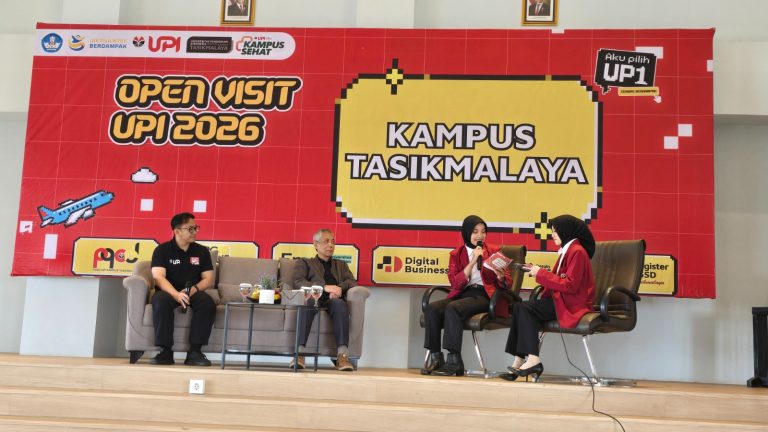
Universitas Pendidikan Indonesia (UPI) Sumedang Campus successfully organized its Open Visit 2026, aimed at introducing its academic environment, facilities, and study programs to the public, particularly prospective students and secondary-school learners from Sumedang and surrounding areas. The event was held on February 14, 2026, at the UPI Sumedang Campus, Jl. Mayor Abdurahman No. 211, Sumedang Regency, West Java.

Responding to Regional Competition

The initiative was inspired by similar Open Visit programs conducted by the main campus, which previously focused on several regional campuses. Recognizing the increasingly competitive higher-education landscape in Sumedang, UPI Sumedang Campus viewed this event as a strategic effort to strengthen its visibility and appeal within the local community.

Prof. Dr. Indra Safari, M.Pd., Director of UPI Sumedang Campus, emphasized the importance of direct engagement with prospective students.

“We consider this Open Visit essential, especially given the number of higher-education institutions in Sumedang. Through this activity, we aim to provide the community with an opportunity to get to know UPI Sumedang more closely,” he stated.

High Public Enthusiasm

The event received an overwhelmingly positive response from the community. Based on online registration data, 370 participants had registered in advance. In addition, many visitors attended without prior registration, having learned about the event through school networks, particularly guidance and counseling teachers.

In total, the number of attendees was estimated to exceed 500 visitors, reflecting strong public interest in UPI Sumedang.

Collaborative Campus Engagement

The Open Visit involved a wide range of campus stakeholders, including:

  • heads of study programs,
  • lecturers,
  • administrative staff, and
  • students.

All participants played active roles in providing information, guiding visitors, and ensuring a meaningful and interactive experience for attendees.

Attracting Future Talent

Through this initiative, UPI Sumedang Campus aims to attract high-potential and competitive students who can contribute to the institution’s academic excellence.

“Our expectation is that this event will help us reach outstanding students who will later achieve success and bring pride to UPI at both national and international levels,” Prof. Indra added.

Conclusion: Strengthening Institutional Competitiveness

The Open Visit reflects UPI Sumedang’s ongoing commitment to:

  • improving the quality of educational services,
  • expanding access to higher-education information, and
  • reinforcing its position as a leading and competitive institution.

By directly engaging with students and their families, this initiative aligns with SDG 4 (Quality Education) supporting inclusive, equitable, and accessible pathways to higher education while contributing to the development of regional human capital. (Rija)

Open Visit at UPI Sumedang Drives Access to Higher Education and Enhances Local Human Capital

18 Feb 2026 • Humas UPI

Sumedang, UPI

The Open Visit 2026 organized by Universitas Pendidikan Indonesia (UPI) Sumedang Campus has received strong appreciation from various stakeholders, including representatives from the Department of Education of Sumedang Regency. Held on February 14, 2026, at the UPI Sumedang Campus, Jl. Mayor Abdurahman No. 211, Sumedang, West Java, the event is regarded as a strategic initiative to expand access to higher-education information and to improve the quality of local human resources.

Expanding Educational Access and Awareness

Dadang Setiawan, S.Ag., M.Si., Head of the Junior High School Division at the Department of Education of Sumedang Regency, expressed his appreciation for UPI’s efforts in introducing higher education to students, particularly those from senior high schools and vocational schools.

He emphasized that the Open Visit provides students with valuable opportunities to directly explore campus facilities, study programs, and future academic and career pathways.

“We highly appreciate this initiative as part of efforts to improve the Human Development Index (HDI), especially through the education sector,” he stated. “Through this activity, students gain a comprehensive understanding of university life and are encouraged to pursue higher education.”

Addressing Educational Challenges in Sumedang

He further noted that the average length of schooling in Sumedang currently stands at approximately 8.92 years, highlighting the need to increase the number of higher education graduates.

Improving participation in higher education is considered essential for developing a workforce that is:

  • high quality,
  • character driven, and
  • globally competitive.

“We hope more young people from Sumedang will continue their studies at UPI Sumedang Campus,” he added. “This will significantly accelerate regional development, as the quality of human resources is the foundation of a region’s progress.”

He also expressed hope that local residents would receive greater opportunities and access to education at UPI Sumedang, ensuring that the campus delivers tangible benefits to the surrounding community.

UPI’s Commitment to Regional Development

The Open Visit serves as a concrete demonstration of UPI’s commitment to:

  • expanding equitable access to higher education,
  • strengthening community engagement, and
  • enhancing the role of universities as centers of knowledge, character development, and innovation.

Through initiatives like this, UPI continues to contribute to both regional and national development by empowering communities through education.

Conclusion: Supporting SDG 4

By bringing higher education closer to students and families, the Open Visit at UPI Sumedang aligns with SDG 4 (Quality Education) promoting inclusive, equitable, and accessible learning opportunities.

This initiative not only broadens educational access but also supports the development of a more capable, competitive, and future ready generation, ensuring that education becomes a key driver of sustainable regional progress. (Rija)

UPI Strengthens Community Engagement through Open Visit at Sumedang Campus

18 Feb 2026 • Humas UPI

Sumedang, UPI

Universitas Pendidikan Indonesia (UPI) continues to demonstrate its commitment to bringing higher education closer to the community through the Open Visit 2026, held at the UPI Sumedang Campus on February 14, 2026. The event took place at Jl. Mayor Abdurahman No. 211, Sumedang, West Java, and was warmly welcomed by the public, particularly residents of Sumedang and surrounding areas.

This initiative served as an important platform to introduce UPI’s study programs, facilities, and student achievements, while strengthening the university’s connection with the local community.

Bringing UPI Closer to the Community

Prof. Dr. Tri Indri Hardini, M.Pd., Vice Rector for Human Resources and Information Systems at UPI and a native of Sumedang highlighted that the event was specifically designed to make UPI more accessible to the local community.

She emphasized that through this Open Visit, the public could directly experience the quality of education, supporting facilities, and the various achievements of UPI students without needing to travel to the main campus in Bandung.

“This event allows the community to better understand UPI and witness firsthand the quality we offer,” she stated.

Equal Quality Across All Campuses

UPI reaffirmed that all its campuses, both central and regional, uphold equal standards of quality. The university operates across several locations, including Bandung, Tasikmalaya, Serang, Purwakarta, and Cibiru, with integrated systems that ensure consistency in academic services, facilities, and institutional coordination.

“The quality of UPI is consistent everywhere,” Prof. Tri explained. “Whether at the main campus or regional campuses, we ensure equal standards so that every student receives the best possible educational experience.”

Strengthening the Development of UPI Sumedang

The Open Visit also represents a strategic effort to further develop the UPI Sumedang Campus. While currently offering undergraduate (S1) programs, the campus has begun expanding into master’s (S2) programs, with plans to introduce doctoral (S3) programs in the future.

This expansion aims to provide wider access to higher education for the people of Sumedang and nearby regions, allowing them to pursue advanced studies without leaving their home area.

Public Trust and Institutional Commitment

UPI leadership expressed appreciation to the organizing committee and the entire academic community of UPI Sumedang for successfully delivering a vibrant and engaging event. The strong public enthusiasm reflects a high level of trust in UPI as a leading and impactful higher education institution.

Through this initiative, UPI continues to strengthen its role as an inclusive, high-quality, and community oriented university, bridging the gap between higher education and society.

Conclusion: Advancing Inclusive Education

The closing message “Don’t forget, choose UPI” served as an inviting call for young people to pursue their higher education at Universitas Pendidikan Indonesia.

By increasing accessibility and strengthening regional engagement, this Open Visit aligns with SDG 4 (Quality Education), promoting inclusive, equitable, and locally accessible learning opportunities for Indonesia’s future generations.

UPI, ITB, and Unpad Synergy Strengthens Education Quality at the Indonesia Physics Olympiad 2026

18 Feb 2026 • Humas UPI

Bandung, UPI

Academic collaboration across leading universities continues to strengthen Indonesia’s national science ecosystem. Lecturers from Universitas Pendidikan Indonesia (UPI), Institut Teknologi Bandung (ITB), and Universitas Padjadjaran (Unpad) joined forces in organizing the Indonesia Physics Olympiad (OFI) 2026, held in Bandung from February 13 to 15, 2026.

Now in its fifth edition, OFI is a collaborative initiative between the Indonesian Scientific Society (ISS) and SEAMEO QITEP in Science. This year’s event also reflects a shared commitment to advancing the Sustainable Development Goals (SDGs), particularly SDG 4 (Quality Education), by promoting high-quality, inquiry-based science learning.

Growing Participation and Competitive Excellence

Since its inception in 2022, OFI has experienced consistent growth in participation. In 2026, a total of 243 high school students from 21 provinces registered for the competition. Following a rigorous selection process, 99 finalists from 10 provinces advanced to the Grand Final, which took place at Hotel De Java, Sukajadi, Bandung.

The academic integrity of the competition was upheld by a distinguished panel of judges, including:

  • Prof. Bobby Eka Gunara (Physics, ITB)
  • Dr. Selly Feranie (Physics, UPI)
  • Dr. Kartika Hajar Kirana, M.Si. (Physics, Unpad)

Their involvement highlights the event’s strong academic foundation and national significance.

Innovative Assessment: Beyond Cognitive Testing

According to Doni Nurdiansyah, Head of OFI 2026, this year’s competition introduced an enhanced assessment format. In addition to traditional paper-based cognitive tests, participants were challenged through a case-study approach.

“This model not only measures conceptual understanding,” Doni explained, “but also evaluates problem-solving skills, creative thinking, scientific literacy, and argumentative communication.”

During the case study stage, participants were presented with randomly assigned problems covering theoretical physics, geophysics, and rock physics. They were allowed to consult scientific journals and references before formulating solutions and presenting them directly to the jury.

This approach mirrors authentic scientific practice, encouraging students to engage in deep, inquiry driven learning.

Physics as a Driver of Technological Advancement

At the closing ceremony on February 15, 2026, jury representative Dr. Selly Feranie emphasized the vital role of physics in technological development from subsurface exploration of the Earth to the study of the universe.

She also encouraged educators to integrate scientific articles and primary research sources into classroom teaching.

“This approach will help students become familiar with deep learning methods and develop the ability to conduct multidimensional analysis of complex problems,” she stated.

Nurturing Future Scientific Talent

Iwan Gunawan, Chair of the Indonesian Scientific Society (ISS), expressed high appreciation for all finalists. He noted that reaching the final stage reflects not only academic ability but also dedication, perseverance, and a strong commitment to science.

Through this synergy, UPI, ITB, and Unpad continue to play a strategic role in nurturing Indonesia’s next generation of scientific talent. The collaboration ensures that students are not only theoretically proficient but also adaptable and prepared to meet future technological challenges.

Conclusion: Advancing SDG 4 Through Collaboration

By combining rigorous academic standards, real-world problem-based assessment, and cross-institutional collaboration, OFI 2026 embodies the spirit of SDG 4 (Quality Education).

The initiative equips young scientists with the knowledge, skills, and mindset needed to contribute meaningfully to Indonesia’s scientific and technological progress ensuring a future generation that is both innovative and globally competitive.

THE HUMOR OF PROF. GARNADI & A JOURNEY TOWARD THE CREATOR

18 Feb 2026 • Humas UPI

By Dinn Wahyudin

Preamble

The late Prof. Dr. Garnadi Prawirosudirjo, MSc, a distinguished biologist and former Rector of IKIP Bandung (1971–1978), devoted nearly his entire life to the service of education.

A senior professor of biology sits quietly at his desk, absorbed in contemplation. With great focus, he examines cells and observes the behavior of insects, ultimately arriving at a simple yet profound realization: the deeper knowledge is explored, the closer humans come to the Creator. For Prof. Garnadi, the microscope was not merely a scientific instrument, it was a window for reflection. Humor, in his view, was not just a means of entertainment, but a subtle pathway to awaken human awareness of its limitations before the grandeur of the universe.

Humor as a Reflection of Biological Truth

Prof. Garnadi was known not only for his sharp scientific insight but also for his remarkable ability to present science with what may be called an intellectual smile. In his classroom, biology was never delivered as a dry or distant discipline. Through calm, structured, and thoughtful speech, he narrated stories of life that often felt ironic when compared to human behavior.

For him, nature particularly the world of insects contained a refined form of humor. This was not artificial humor, but one that emerged naturally from the efficiency and logic of biological systems. It was too precise and meaningful to ignore.

His students often responded with quiet laughter, not because the examples were merely amusing, but because they felt subtly confronted by the truths reflected in nature.

The Lesson from Ant Colonies

One of Prof. Garnadi’s most memorable examples came from the study of ant colonies, a field of his expertise.

Most ants we observe work tirelessly: searching for food, carrying heavy loads, caring for larvae, and maintaining the nest. These tasks are performed by female ants, which are sterile, do not reproduce, remain largely unnoticed, and never stand as heroes within the colony.

In contrast, male ants have a very brief biological role: they appear at a specific time, mate with the queen, and then die.

When presenting this reality, Prof. Garnadi delivered his insight with calm authority and gentle humor. Through this, nature seemed to convey a deeper message:
function is more important than status, and efficiency outweighs symbolism.

The laughter that followed was not superficial—it was reflective. The division of roles in nature is clear, firm, and almost without compromise.

Nature, Adaptation, and Human Misconceptions

The discussion becomes even more meaningful when linked to patterns of ant activity. While worker ants are indeed female, not all are active at night. Their behavior depends on species and environmental factors such as temperature, humidity, predators, and food availability.

In tropical regions, many species are more active in the evening or nighttime due to cooler temperatures and reduced risk of dehydration.

At this point, Prof. Garnadi would gently remark:
“Nature does not recognize stereotypes; it only recognizes adaptation.”

Here, humor arises not from incorrect facts, but from the human tendency to oversimplify nature using social assumptions.

Biology as a Language of Humanity

What makes Prof. Garnadi’s humor particularly distinctive is that it never descends into harsh satire or biased jokes. Instead, it functions as a form of biological irony and subtle social reflection.

The hardworking, efficient, and nearly invisible female ant is contrasted with the briefly present male ant whose role quickly concludes the game is over. Nature itself is not judging, yet humans often smile because they recognize a reflection of their own social realities.

In this way, biology becomes a language of humanity
offering critique without lecturing, and teaching without moralizing.

Ultimately, for Prof. Garnadi, humor was both a pedagogical strategy and an intellectual stance. Knowledge does not need to be delivered with rigidity or intimidating jargon. With sensitivity and scientific precision, even the life of insects can illuminate values such as discipline, sacrifice, efficiency, and rationality.

Biological humor, therefore, is not about laughing at nature, but about laughing at human seriousness that often forgets that nature has “thought” long before humans learned to think about it.

Toward the Creator

Prof. Garnadi viewed the relationship between science and faith not as opposing domains, but as complementary ways of understanding reality.

Science enables humans to comprehend the order of the natural world, the mechanisms of life, and the laws governing empirical phenomena. Faith, on the other hand, provides meaning, direction, and ethical guidance for how that knowledge should be used.

As a biologist, he believed that deeper scientific understanding opens the path toward a more mature spiritual awareness. The complexity of life, the harmony of natural systems, and the precision of biological interactions evoke a sense of awe and humility before the Creator.

For him, science is a quiet journey toward transcendental awareness an intellectual path that ultimately leads to the recognition of a greater divine order.

Thus, the integration of science and faith becomes a vital foundation for:

  • the advancement of knowledge,
  • the formation of ethical values, and
  • the development of holistic human character.

Science explains the world as it is, while faith guides how humans ought to live within it. Together, they move in harmony and in that meeting point, humans find their way back to the Creator.

Closing Prayer

May the late Prof. Dr. Garnadi Prawirosudirjo rest peacefully in the Alam Barzah, honored in the sight of Allah SWT.

Allahummaghfir lahu, warhamhu, wa’afihi, wa’fuanhu.
O Allah, forgive him, have mercy upon him, grant him peace, and pardon him.
Amin, Ya Mujib as-Sa’ilin.

References

Garnadi Prawirosudirjo. (1974). The Amazing Lives of Insects. Jakarta: Bhatara.
Garnadi Prawirosudirjo. (1975). The Integration of Science and Faith. Jakarta: Bulan Bintang.

SDG Connection

This reflection aligns with SDG 4 (Quality Education) by demonstrating how the integration of science and faith can enrich learning, foster critical thinking, and cultivate ethical awareness in education.

Search